Amazon restricted keywords for cosmetics usually don’t come from careless sellers, they come from ordinary marketing habits. Writing “clinically proven,” “treats acne,” or “reverses aging” feels like normal benefit-led copy, the same language that sells on a website or in a magazine ad. On Amazon, that same instinct is exactly what turns a cosmetic claim into an unapproved drug claim, and it’s often the reason a listing that was already performing well gets suppressed within hours.
This guide is for US and Turkish brand owners and listing managers selling cosmetics, skincare, or personal care products on Amazon US, and for anyone preparing to launch the same product catalog in the EU or UK. You’ll get the specific wording that triggers a flag, compliant alternatives that still convert, and how the rules shift once the listing goes live in Europe.
Why Cosmetic Listings Keep Crossing Into Drug Claims
The FDA doesn’t require pre-approval for cosmetic labeling, and it doesn’t publish an official list of banned words. What it regulates is intent. A product counts as a cosmetic when it cleanses, beautifies, or changes appearance.
If a listing claims the product treats a condition, prevents a disease, or affects the structure or function of the body, FDA may regulate it as a drug based on that intended use, even if the product is otherwise marketed as a cosmetic and the formula never changed. Supplements have their own related category called structure/function claims, but for cosmetics, the FD&C Act’s drug definition is what actually applies.
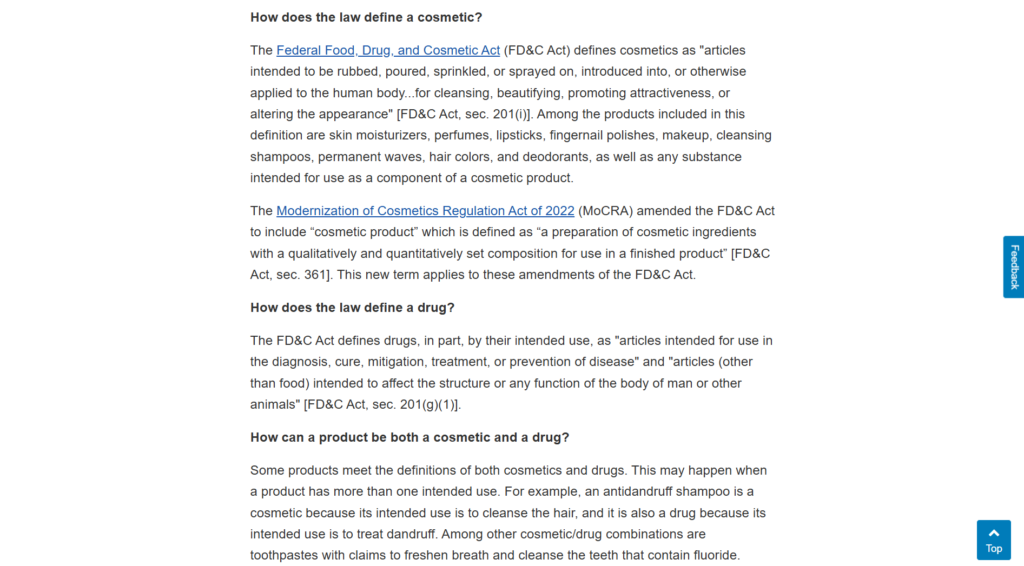
FDA cosmetic claims policy doesn’t work off a banned-word list; it evaluates the overall impression a claim creates, whether that’s on the label, in a bullet point, or inside an Amazon A+ module. The FDA lays this distinction out clearly in its own guidance on the line between a cosmetic and a drug.
That distinction is exactly why Amazon restricted keywords for cosmetics matter to sellers who never intended to make a medical claim. A bullet point that says a serum “heals eczema” or “treats acne” reads like marketing to a founder, but it reads like an unapproved new drug claim to Amazon’s compliance systems and to the FDA.
The gap between those two readings is where most suspensions start. Getting cosmetic vs drug claims right in every field is the first line of defense.
Amazon Restricted Keywords for Cosmetics, What You Can and Can’t Say
Amazon restricted keywords for cosmetics aren’t a simple published list, the real question is whether the wording creates a prohibited drug claim or otherwise breaks Amazon’s listing policies. Amazon uses both automated systems and manual compliance reviews to evaluate cosmetics listings, checking titles, bullet points, descriptions, A+ Content, and even backend search terms.
Words That Trigger a Drug Claim
These phrases push a cosmetic listing into drug territory almost every time:
- “Treats,” “cures,” “heals,” or “prevents” any condition (acne, eczema, psoriasis, dandruff)
- Anti-aging claims like “reverses aging” or “eliminates wrinkles,” instead of describing appearance
- “Clinically proven” without documentation Amazon can verify
- “FDA approved” for a product never submitted for drug approval
- “Anti-inflammatory,” “antibacterial,” or “antiviral” claims
- Disease names paired with any benefit (“psoriasis relief,” “eczema relief”)
Compliant Alternatives That Still Sell
None of this means the copy has to sound flat. Swapping the outcome for the sensation or the appearance keeps the benefit while staying clear of the Amazon restricted keywords for cosmetics listed above:
- “Reduces the appearance of wrinkles” instead of “reverses aging”
- “Cleanses and clarifies skin” instead of “treats acne”
- “Enhances radiance” instead of “heals dullness”
- “Supports a smooth, hydrated look” instead of “repairs damaged skin”
It’s worth reviewing this wording across every field, not just the title, before Amazon does. A professional listing copywriting review can catch these gaps early.
How EU and UK Cosmetic Claim Rules Differ From the US
US-focused compliance doesn’t fully carry over once a catalog lists on Amazon Germany, France, or the UK. The claim rules are related, but stricter in some ways and structured differently in others.
EU Regulation 655/2013 (Claims Regulation)
Under the EU’s Cosmetic Products Regulation, a separate rule, Regulation (EU) 655/2013, sets six common criteria every cosmetic claim must meet:
- Legal compliance, a claim can’t imply official approval that doesn’t exist
- Truthfulness, an ingredient claim has to reflect what’s actually in the formula
- Evidential support, the benefit needs real substantiation, not just implication
- Honesty, a claim can’t overstate results beyond what the evidence actually shows
- Fairness, claims can’t disparage or misrepresent competing products
- Informed decision-making, the claim has to give shoppers enough to judge the product accurately
A European Commission review of tens of thousands of cosmetic claims found roughly one in ten failed to meet those criteria, most often online rather than on the physical label. That’s exactly where Amazon EU listings tend to get flagged.
UK Rules After Brexit
The UK retained a closely aligned cosmetic claims framework after Brexit, enforced through its own domestic Cosmetic Products Enforcement Regulations. In practice, a claim that fails EU criteria will almost always fail UK criteria too, so checking copy against one usually covers both.
Sellers moving a catalog from Amazon US to Amazon EU or UK for the first time typically need more than a translation pass, the claims themselves have to be re-checked against a different regulator. That gap is easy to miss during a standard translation or listing-localization pass, which is why claims should get reviewed separately for each marketplace. An Amazon consulting engagement typically covers exactly this kind of check.
Common Mistakes That Get Cosmetic Listings Suspended
An Amazon listing suspended over a claim rarely comes back without a full compliance review. Most suspensions don’t start with an obviously reckless claim, they start with small, repeatable habits:
- Leaving old “clinically proven” or “treats” language in backend search terms after cleaning up the visible listing
- Letting an A+ Content module repeat a claim already removed from the title and bullets
- Reusing a manufacturer’s marketing deck word-for-word, including disease references meant for a regulatory submission, not an Amazon listing
- Allowing influencer or review-request scripts to make claims the brand itself avoided in the listing
- Assuming a claim is safe because a competitor in the same Amazon beauty category uses it, Amazon can flag one seller’s listing without touching another’s
- Translating a US listing into German, French, or Italian without re-checking whether the translated claim still reads as compliant in that language
This article focuses specifically on claims and listing language. If a shipment is getting flagged for packaging, labeling format, or seal requirements instead, that’s a separate FBA prep issue covered in our cosmetics FBA prep checklist.
Quick-Reference Table: Compliant Wording vs. Restricted Keywords
Keep this table next to the listing before publishing anything new. It covers the phrases most commonly flagged as Amazon restricted keywords for cosmetics, next to wording that keeps the same selling point.
| Restricted Wording | Compliant Alternative |
| Treats acne | Cleanses and clarifies skin |
| Heals eczema | Soothes and softens skin |
| Reverses aging | Reduces the appearance of fine lines |
| Clinically proven results | Formulated with [ingredient] |
| FDA approved formula | Formulated to meet FDA cosmetic labeling requirements |
| Anti-inflammatory | Calming, gentle formula |
| Cures dark spots | Brightens the look of skin |
Claim rules are only part of what governs a beauty listing in Europe. The wider picture is in our Amazon EU compliance guide.
Claim wording is the single most common reason a beauty listing disappears. It is one of the things we handle as an Amazon agency for beauty and cosmetics brands.
Conclusion
The fastest way to protect a cosmetics catalog is to audit every field where claims appear, not just the title and first bullet. Titles, bullets, descriptions, A+ Content, image text, and backend search terms can all affect listing compliance, and a claim removed from one field but left in another can still get flagged.
Run every draft past someone who tracks the current Amazon restricted keywords for cosmetics before it goes live, not after a suppression notice arrives. A short wording review before publishing costs far less than the days it usually takes to get a suppressed listing reinstated. Compliant cosmetic marketing claims protect both the listing and the account behind it. Book a free consultation and get the listing reviewed before Amazon flags it.
FAQ
1. Why did Amazon Suspend My Cosmetic Listing?
Most cosmetic suspensions come from wording that reads as a drug claim, “treats,” “cures,” or “clinically proven” without proof Amazon can verify. The claim can be hiding in the title, bullets, A+ Content, or backend search terms, not just the visible copy.
2. Do Cosmetics Need FDA Approval Before Selling on Amazon?
No. FDA generally does not require pre-market approval for cosmetics. Amazon doesn’t require it as a standard step either, though sellers may still need to provide compliance documentation depending on the product and marketplace.
3. What’s the Difference Between a Cosmetic and a Drug Claim?
A cosmetic claim describes cleansing, beautifying, or changing appearance. A drug claim describes treating, curing, or preventing a condition, or changing how the body functions, even when the product itself never changes.
4. What Happens if Amazon Flags a Restricted Keyword in Listing?
Amazon can remove the flagged content, suppress the listing from search, or lock the detail page for editing. Sellers typically see a Performance Notification in Seller Central under Account Health explaining the issue.
5. Are EU Cosmetic Claim Rules Different From FDA Rules?
Yes. The EU applies its own Cosmetic Claims Regulation with criteria for truthfulness and evidence, and the UK enforces a similar framework after Brexit. A claim compliant in the US isn’t automatically compliant once the listing goes live in Amazon’s EU or UK stores.