If you’re an Amazon seller, you’ve probably heard of Amazon A+ Content and how it affects a store’s sales and conversions. But what exactly is Amazon A+ Content, and how can you create it? We cover everything you need to know to get started in this short guide!
Introduction to Amazon A+ Content
Importance of standing out on Amazon
There are over 1 million sellers (and growing) currently on Amazon US, so the competition is pretty fierce. Standing out on Amazon means you’ll attract more paying customers than your competitors, increasing your profits and getting more exposure to your storefront.
Utilizing Amazon’s tools to improve product listings
Using Amazon’s tools, like Amazon A+ Content, allows you as the seller to improve the appearance and helpfulness of your product listings. More professional product listings are more likely to convert window shoppers into paying customers.
What is Amazon A+ Content?

Enhanced Brand Content, now known as A+ Content
Amazon A+ Content, previously known as “Enhanced Brand Content” is a feature that Amazon offers to select sellers to enhance the images of their listings, add HD videos, and use helpful design elements like text or comparison charts to sway buyers.
Available for brand-registered third-party sellers and vendors
Amazon A+ content is available only for brand-registered sellers and vendors. Amazon A+ can only be used for 15 ASINs each month.
Benefits of Amazon A+ Content
Here are some of the benefits of using Amazon A+ Content for your products:
Stand out from the competition
A+ Content can help you differentiate your products from other sellers who may have similar or identical items. By adding visual and interactive elements, you can capture the attention of shoppers and persuade them to choose your products over others.
Boost sales and profits
A+ Content can help you increase your sales and profits by improving your conversion rates and reducing your return rates. By providing more information and details about your products, you can help customers make informed purchase decisions and reduce the chances of them being dissatisfied or disappointed with their orders. You can also use A+ Content to cross-sell or upsell your other products and increase your average order value.
Increased conversions and brand awareness
A+ Content can help you establish your brand identity and reputation on Amazon. By telling your brand story and showcasing your values, you can build a connection with your customers and increase their trust in your products. Listings with Amazon’s A+ Content result in anywhere between 3 and 10% higher conversions than regular content. The average conversion rate with Amazon A+ is 5.6% higher.
Enriched customer experience through visuals and text
The enhanced visuals brought to customers makes the buying process more appealing, easier to skim, and gives your brand a positive image. You can also use A+ Content to display customer reviews, testimonials, awards, or certifications that demonstrate your product quality and reliability.
Creating Amazon A+ Content
Accessing A+ Content Manager in Seller Central
To create Amazon A+ Content, follow the steps below:
- Login to your brand-registered Seller Central.
- Click “Advertising,” then click “A+ Content Manager.”
From there, you can start building your A+ Content.
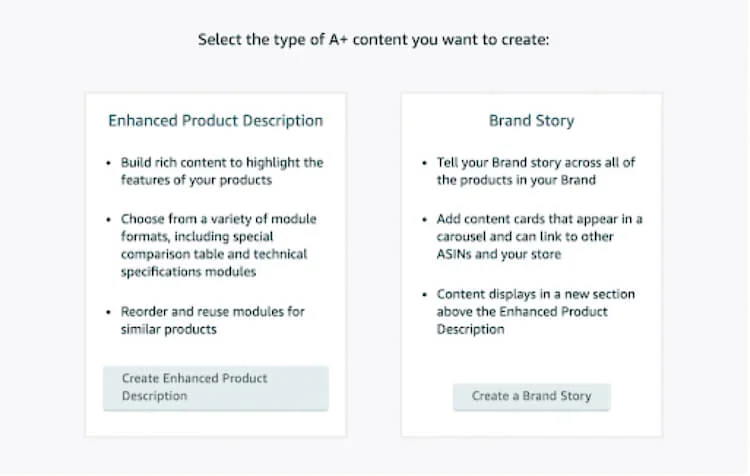
Choosing between “Enhanced Product Description” or “Brand Story”
Amazon offers 2 types of A+ content to create: an Enhanced Product Description or your Brand Story.
- Enhanced Product Description: Highlight your products with tables, specifications, and more.
- Brand Story: Tell your brand’s story and highlight your store as a whole.
Adding modules for images and text
According to Amazon, “When you create A+ Content, you can choose between 17 modules to design your detailed page layout.” These modules let you customize your store with eye-catching images, text, and more.
Optimizing Amazon A+ Content
Creating effective A+ Content requires some planning and optimization. Here are some tips to optimize your Amazon A+ Content:
Follow the guidelines
Amazon has strict guidelines for A+ Content, such as size, format, and content requirements. Make sure you follow these guidelines to avoid rejection or removal of your A+ Content. For example, you should not include any pricing, promotional, or warranty information in your A+ Content.
Crafting engaging content with images and text
Use images and text to show how products can benefit customers and expand on your product’s features.
TIP: Text can expand customers’ understanding of a product, but too much text appears wordy and can hurt your conversion rate.
Telling a compelling brand story
To tell a compelling brand story, you need to:
- Identify with your target audience. If you’re selling baby accessories, appeal to young women.
- Share your brand’s goals and values (such as improving the lives of mothers and babies).
- Be authentic, honest, and communicative.
Showcasing features, benefits, and specifications
Highlight the best features of your products, share how they can fit into your customers’ lives and benefit them, and include specifications in your listings such as height, weight, variations, etc.
Use the right modules
Amazon offers different modules for A+ Content, such as comparison charts, product description, image gallery, and more. Choose the modules that best showcase your product’s features and benefits, and avoid using too many modules that might overwhelm the customers.
Testing and Measuring Results
Amazon provides analytics tools to help you measure the performance of your A+ Content. You can track metrics such as impressions, clicks, conversion rates, and sales. Use these data to test different versions of your A+ Content and see what works best for your product and target audience.
Monitoring conversion rates and unit session percentage
Follow these steps to monitor conversion rates:
- Click “Reports,” then click “Business Reports.”
- Here, you’ll find sales and traffic to your store to review.
- Scroll down to “Order Item Session Percentage” to find your conversion rate.
A/B testing different layouts and images
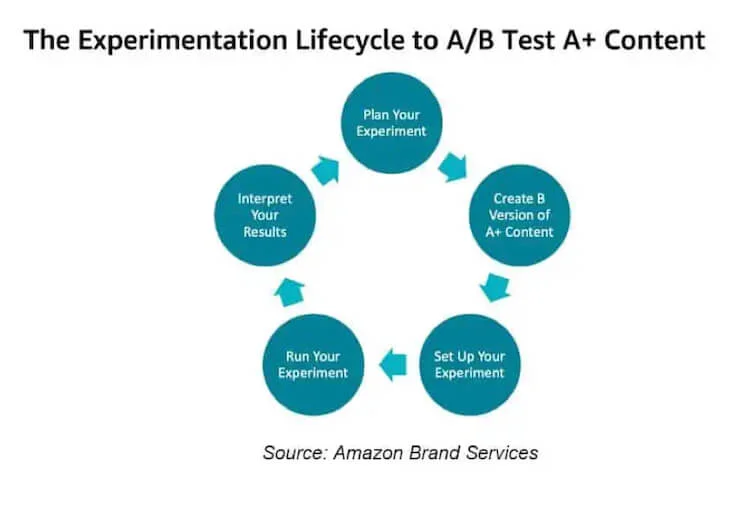
A/B testing involves creating two similar listings, one with enhanced A+ Content and one without. Monitor the conversion rates over a period of a few weeks or months.
Utilizing Amazon’s beta tool for experiments
Amazon’s beta tools lets sellers measure how aspects like comparison tables, better images, banners, and descriptions impact their conversion rates.
Basic A+ vs. Premium A+ Content
Once you start building A+ Content, you’ll notice Amazon offers more than one version. Here’s how they differ and which one makes sense for your brand.
The three types of A+ Content
Amazon currently offers three types of A+ Content:
- Basic A+ Content: The free, standard version with custom text, enhanced images, and comparison charts.
- Premium A+ Content: An advanced version with bigger visuals, video, and interactive modules.
- Brand Story: A carousel shown in the “From the Brand” section across all your listings.
What Premium A+ adds
Premium A+ Content gives you more space and more tools to present your product, including:
- Larger, high-resolution images (1464 x 600 px instead of 970 x 300 px)
- Up to 7 modules per product page instead of 5
- Multiple video modules
- Interactive hover hotspots
- Clickable image and video carousels
- Q&A modules
- Comparison charts with an “Add to Cart” button
According to Amazon, Basic A+ Content can raise sales by up to 8%, while Premium A+ Content can raise them by up to 20%.
Who qualifies for Premium A+
To unlock Premium A+ Content, you need:
- A Professional selling account and Amazon Brand Registry.
- A published Brand Story on all of your brand-owned ASINs.
- At least five A+ Content projects approved and published in the last 12 months.
Amazon checks eligibility every week. If you qualify, Premium A+ is switched on automatically in A+ Content Manager, and you’ll see a banner with a link to start building. You don’t need to contact Amazon.
TIP: Premium A+ Content is currently free during Amazon’s promotional period. If Amazon starts charging for it, you’ll have to opt in, so no fees are applied without your consent.
Is Premium A+ worth it?
Premium A+ suits established or growing brands that already have strong visual assets. To use video, carousels, and full-width images well, you’ll need professional photography, video, and design, and that can be a big upfront cost. Before Premium A+ became free for eligible sellers, it was only available through Vendor Central and came with a very high price tag.
Treat the choice as a product-by-product decision, not a brand-wide one. Premium A+ makes the most sense for your best sellers, while Basic A+ is often enough for smaller SKUs. If you want help planning this, see our A+ Content and Brand Story service.
Where Brand Story fits
Brand Story appears under “From the Brand” on your product pages. It’s one module made up of up to 19 image-and-text cards in a carousel. Use the cards to share your history and values, show your main visuals, and link to other products or your Amazon Brand Store.
It’s worth the effort. In a 2024 Statista survey, nearly nine in ten consumers named trust as a key factor in which brands they buy from. A published Brand Story on all your ASINs is also one of the requirements for Premium A+.
A+ vs. B+ Content
“B+ Content” isn’t an official Amazon term. Some sellers and agencies use it to describe the core parts of a listing: the title, bullet points, main image, and image stack. A+ Content works alongside these elements, not instead of them.
A+ Content Approval and Compliance
How long approval takes
Amazon reviews every A+ Content submission before it goes live on your product page. Approval normally takes up to seven business days. If your content is rejected, edit it based on Amazon’s feedback and resubmit it for another review.
What else Amazon won’t allow
Beyond pricing, promotions, and warranties, Amazon will also reject A+ Content that:
- Mentions or refers to competitors, directly or indirectly. Comparison charts can only include your own brand’s products.
- Breaks Amazon’s adult product and content policies or refers to criminal activity.
- Uses images or text you don’t hold the rights to.
Check Amazon’s full A+ Content guidelines before you submit.
How to Build a Comparison Chart That Converts
Shoppers often compare options before they buy. If your listing doesn’t help them do that, they’ll leave to check other pages and may not come back. A good comparison chart keeps them on your page, helps them choose faster, and shows them your higher-end models or matching products.
Limit the chart to 3-5 products
Too many columns make the chart crowded and force shoppers to move their eyes back and forth. With three to five products, the differences are easy to see at a glance.
Order products from basic to premium
Think of your chart as a lineup: basic, premium, and professional. Put the simplest option first and let each column be a clear step up. Then choose one hero product, usually the one with the best mix of features and price, and place it in the middle column. A small label or design accent helps it stand out.
Give each product a clear reason to exist
If every column shows the same features, the chart doesn’t help anyone. Point out one or two standout features for each product, such as a bigger size, better performance, or a feature for a specific type of user, so shoppers understand why one costs more than another.
Group features into logical rows
Organize rows the way shoppers naturally judge a product:
- Size and capacity: dimensions, weight, and storage space
- Key functions: the main features or core abilities
- Target users: beginners, casual users, or professionals
- Special features: the advantages that make each product stand out
Use checkmarks, icons, and consistent images
Checkmarks let shoppers scan a row and spot differences instantly. A few simple icons, for things like battery life or waterproofing, work faster than text, but too many turn the chart into clutter. Keep product images consistent in angle, lighting, and size, and match the chart’s colors and fonts to the rest of your A+ Content.
Common A+ Content Mistakes to Avoid
Even a great product can lose sales when its A+ Content misses the mark. Here are the most common mistakes and how to fix them.
Focusing on design over value
Flashy A+ Content grabs attention, but if it doesn’t explain why the product is worth buying, it won’t convert. To fix it, lead with benefits, pair images with short and clear text, and show the product in real-life use instead of piling on decorative graphics.
Burying your unique selling point
Listing features isn’t enough. Shoppers won’t work out what makes your product different on their own. To fix it, state your USP in one strong line, connect each feature to a real benefit, and repeat the USP across your visuals.
Using low-quality or inconsistent images
Blurry, poorly lit, or stretched images make a product look cheap, even when it isn’t. Mixing different backgrounds and color tones also makes the page look messy and weakens your brand. To fix it, use sharp, high-resolution images, keep lighting and backgrounds consistent, and never resize images in a way that distorts them.
Designing for desktop first
Most Amazon shoppers browse on their phones. On mobile, modules stack vertically, so crowded sections turn into long scrolls, and small text built into images becomes unreadable. To fix it, design for mobile first, keep text short and large, leave more space between elements, and check your A+ Content on a real phone before publishing.
Skipping the comparison chart
If you sell several similar products, leaving out a comparison chart forces shoppers to work out the differences from text alone. That slows them down and sends them to other listings. Add a simple chart using the steps above.
Telling a brand story without proof
A brand story builds trust only when shoppers believe it. To fix it, back up your values with proof, such as certifications, years of experience, or your real background, and use visuals that match your brand’s tone.
FAQs
1. What is the A+ category on Amazon?
Amazon A+ lets sellers add tables, images, text, high-def videos, and other features to their content to enhance their listings.
2. What is an example of good A+ content?
Some examples of good A+ content include banners, 360-degree product views, your company logo, and what’s-in-the-box infographics.
3. Is Amazon A+ content worth it?
If you want to get your store in front of the competition and increase your sales potentially by 10%, Amazon A+ Content is worth using.
Conclusion
Amazon A+ content is a great way to get your store in the limelight with its features to enhance the display of your products and create a better shopping experience for your store visitors.