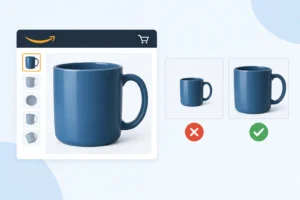
When a cosmetics shipment gets refused, the problem often isn’t the product itself. It can come down to a single prep detail: a leaking cap, a date in the wrong format, or an FNSKU covering the batch code.
That’s why cosmetics are one of the easiest categories to get wrong on Amazon FBA, even though they can be highly profitable. The problem is rarely the product or the ads. It’s prep, and cosmetics come with rules standard items don’t have: expiry dates, tight seals, and in some cases drug or hazmat classification.
This checklist covers what to do for each product type: skincare, makeup, fragrance and haircare. It also shows what gets each one refused and what a failed prep actually costs. And it flags the exception that catches sellers out: sunscreen, which the FDA treats as a drug rather than a cosmetic.
Quick reference by product type
| Product type | What Amazon expects | Where sellers go wrong |
| Skincare: creams, serums, toners | Leak-proof seal, a poly bag where the prep category requires one (with a suffocation warning if the opening is 5 inches / 12.7 cm or larger), expiry date on each unit | Weak seal, missing poly bag, date in the wrong format or hidden under the FNSKU |
| Makeup: liquids (foundation, concealer, liquid lipstick) | Same as above, plus shrink wrap or tape around the cap | Leaks, units that open in transit |
| Makeup: powders, palettes, compacts | Snug packaging that stops movement, bubble wrap for fragile cases | Broken pans, cracked cases, oversized boxes |
| Fragrance and nail polish | Check dangerous goods status before prep; an SDS or exemption sheet may be required | Shipping before hazmat approval or documents are in place |
| Haircare: shampoo, conditioner | Treated like liquids: seal, plus a poly bag where required | Loose caps; sprays and aerosols fall under hazmat |
| Sunscreen (US) | Regulated as an OTC drug, not a cosmetic; confirm FDA drug labeling before prep | Prepping and listing it as if it were a cosmetic |
| Sets and multi-packs | Items bound together, a “Sold as set” label, one FNSKU for the whole set | Items that can be separated, or barcodes of the items inside left visible |
What Amazon Considers “Cosmetics”
When selling on Amazon, one of the first things you need to get right is product classification. So, what exactly does Amazon consider “cosmetics”? Anything applied to the human body for cleansing, beautifying, promoting attractiveness, or altering appearance, without affecting the body’s structure or functions.
According to Amazon’s definition, cosmetics typically include five main groups:
- Makeup: foundation, concealer, lipstick, mascara, eyeliner, face powder
- Skincare: facial cleansers, toners, serums, moisturizers, face masks
- Haircare: shampoo, conditioner, styling products, hair serums
- Fragrance: perfume, body mist, perfume oils
- Beauty-related personal care: body lotions, lip care products, skin treatments
Here’s a quick check you can use: Does your product clean, enhance, or scent the body without making medical claims? If yes, Amazon will almost certainly treat it as a cosmetic. Understanding this early helps you prepare the right compliance documents and avoid listing issues later.
One exception catches sellers out: sunscreen. In the US, the FDA regulates sunscreen as an over-the-counter drug, not a cosmetic, because it claims to protect against sunburn. In the EU and UK, the same product is treated as a cosmetic. If you sell in both, one SPF cream sits under two different regimes. Moisturizers and makeup with SPF claims can be both a cosmetic and a drug. Check which rules apply before you prep, because the cosmetic guidance in this checklist doesn’t cover FDA drug labeling and listing rules.
Packaging Requirements for Amazon FBA Cosmetics
Packaging is not just about branding or aesthetics. It directly affects whether your inventory is accepted, damaged, or even destroyed. Many sellers lose money simply because they miss one small FBA packaging rule. Let’s walk through this step by step, in plain language.
General FBA Packaging Rules
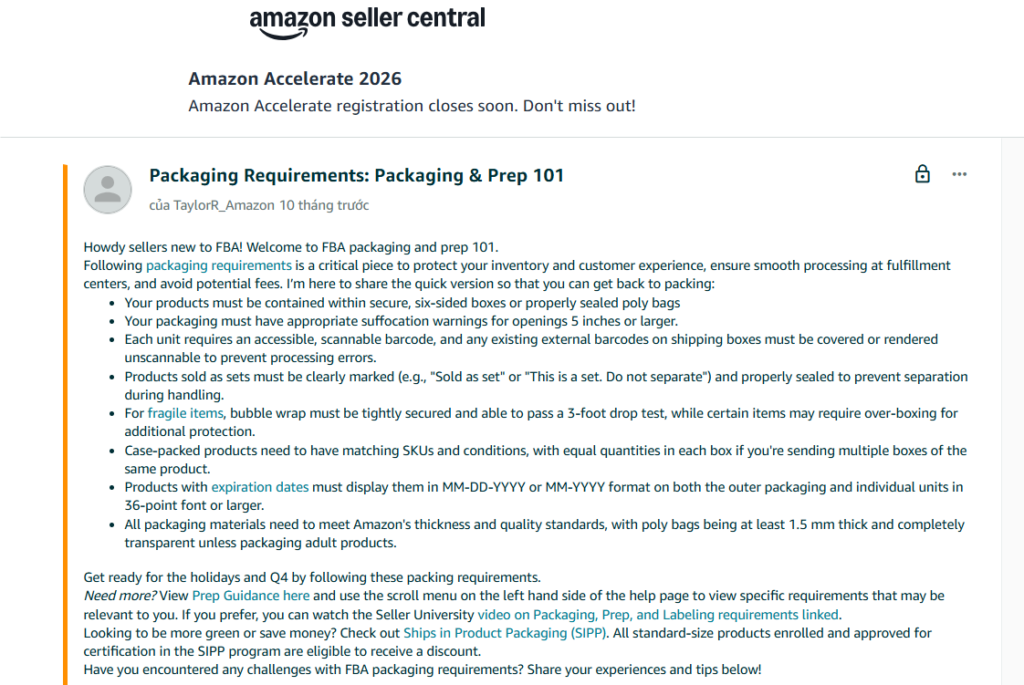
Source: Amazon Seller Central
Amazon cares about consistency and safety. Every cosmetic product must:
- Have a scannable barcode (for most cosmetics, an FNSKU label)
- Be fully sealed and ready for fulfillment
- Withstand shipping, stacking, and warehouse handling
Amazon does not accept products with loose packaging, exposed items, or labels that can peel off easily. If the item can open during transit, Amazon will flag it.
Quick check for sellers: shake the product gently. If it moves freely inside the box, your packaging likely needs improvement.
Liquid & Cream Products
Liquid, gel, and cream cosmetics are considered high-risk items in Amazon fulfillment centers. Amazon expects them to be packed so they can’t leak in storage or transit. Depending on the product’s prep category, that can mean:
- A leak-proof seal (tamper-evident where applicable)
- Secondary containment, such as a sealed poly bag
- A suffocation warning on any poly bag with an opening of 5 inches (12.7 cm) or larger, measured flat
Poly bags used for FBA should be transparent, fully sealed and at least 1.5 mil thick, with a barcode that scans through the bag or an FNSKU label on the outside.
Extra protection matters here. Even well-designed bottles can leak under pressure, and shrink wrap or secure tape around the cap can reduce spill risk. Check your SKU’s prep guidance in Seller Central to see whether a poly bag is required for your product.
Fragile & Glass Containers
Glass packaging looks premium, but in a fulfillment center what matters is whether it survives handling.
For fragile or glass cosmetic containers:
- Enclose each unit in bubble wrap or another approved protective method, or use a six-sided box
- Check whether Amazon’s 3-foot drop test applies to your prep category
- Prevent direct contact between the item and the outer carton
- Use a snug-fitting box with internal padding
The same goes for pressed powders, palettes and compacts. Leaking or broken units may be disposed of without reimbursement, so a cracked pan is a lost sale, not just a cosmetic flaw. A common mistake is using oversized boxes. Too much empty space allows movement, which increases breakage risk. Tight, reinforced packaging performs better in FBA warehouses.
For drop-test rules and box sizing across other breakable categories, see our FBA prep checklist for fragile products.
Sets, Bundles & Multi-Packs
Selling skincare sets, beauty bundles, or multi-packs as a single listing? This is where many sellers run into trouble.
Amazon’s guidance for sets is to:
- Keep all items in the set securely bound together
- Add a label that clearly says the products are received and sold as one unit, such as “Sold as set,” “Ready to ship” or “This is a set. Do not separate.”
- Give the set its own FNSKU, and make sure the barcodes of the items inside are covered or not visible
This helps warehouse associates scan the barcode for the pack, not the barcodes of the individual units inside it.
Labeling Checklist for Cosmetics Sold via FBA
In Amazon FBA Prep, labeling is where many sellers get tripped up, often without realizing it.
Required Product Label Elements
Every cosmetic product sold via FBA must include specific label elements. Miss one, and Amazon can flag your listing or block your inventory.
Here’s what your physical product label must clearly show:
- Product name: This should match your Amazon listing exactly. Different wording = potential mismatch issue.
- Net contents: Use the units of the marketplace you sell in. In the US, state net contents in US customary units (fl oz for liquids, oz for solids) with the metric equivalent alongside (mL or g). In the EU, state the nominal content in metric units: millilitres (ml) for liquids and pastes, grams (g) for solids and powders. Whichever you use, be precise and consistent with your listing.
- Ingredient list (INCI format): List ingredients in descending order by weight. No marketing language here, just facts.
- Manufacturer or Distributor information: Include the company name and location. This can be your brand or a contracted manufacturer.
- Country of origin: “Made in…” or “Product of…” must be clearly visible. Amazon checks this more often than you think.
FNSKU & Barcode Rules
For Amazon FBA Prep, plan on an FNSKU label for cosmetics. Amazon requires expiration-dated products to carry an Amazon barcode label, and most cosmetics fall into that group. Check your barcode setting in Seller Central: if it is set to Amazon barcode, any other scannable barcode (UPC/EAN) must be covered or removed so the FNSKU is the only one that scans. The barcode must be scannable and not placed over seams or curves. If Amazon scans the wrong barcode, your inventory can be misattributed, or worse, marked as unfulfillable.
One cosmetics-specific trap: don’t place the FNSKU over required product information such as the expiration date, lot or batch code, or ingredients. Covering a required field can get the unit flagged at receiving.
Expiration Date & Lot Code Requirements
Amazon treats most cosmetics as expiration-dated products. Under its FBA policy, that covers any topical product for human use, and any product with a printed expiry date, a period-after-opening symbol or a recommended shelf life. It also applies to products that lose effectiveness over time, even when no date is printed on the pack. Here is what Amazon expects:
- Format: MM-DD-YYYY or MM-YYYY, always with a four-digit year. Numeric formats are preferred, and a month abbreviation such as 01-JAN-2027 is also accepted. If the printed date is in another format, apply a label with the date in the correct format over it. Don’t cover other required information, such as ingredients, drug facts, net contents or distributor details.
- Placement: on each unit and on the outer carton. The 36-point-or-larger font requirement applies to the carton; on each unit the date must be clearly readable. A lot code alone is not enough. If a poly bag or bubble wrap hides the date, add a label with the expiration date on the outside of the prepped unit.
- Printed, not handwritten: use a printed label in a human-readable font.
- Lot or batch code: Amazon requires expiration-dated products to be lot-controlled, so keep the code visible for traceability.
- Shelf life on arrival: Amazon’s policy is a remaining shelf life that covers the time a customer needs to use the product, plus an additional 90 days. For example, a cream that takes two months to finish should arrive with roughly five months left.
- The 50-day cutoff: in the US, units within 50 days of expiry are removed for disposal, and disposed units can’t be returned to you. Buffers can differ by category, so check the guidance for yours.
Language & Legibility
All required labeling must be in English for the US marketplace. More importantly, it must be easy to read. Avoid tiny fonts, low-contrast colors, and labels that smudge or fade. If a warehouse associate can’t read it quickly, Amazon won’t approve it.
Compliance & Regulatory Considerations
Amazon is strict with Amazon FBA Cosmetics because these products are applied directly to the human body. One missing document or one wrong claim can pause your listing, or worse, suspend it.
FDA Compliance (US Market)
First question many sellers ask: Do cosmetics need FDA approval before selling on Amazon? No pre-approval, but full compliance is required.
In the US, cosmetics are regulated by the FDA under the Federal Food, Drug, and Cosmetic Act. This means your product must be safe for consumer use and properly labeled, including ingredient disclosure and manufacturer information. Amazon may also ask for additional information or documentation before an ASIN can be sold or sent to FBA. These are two separate sets of rules, and meeting one doesn’t guarantee the other.
Also, don’t confuse cosmetics with drugs. If your product claims to treat acne, heal skin conditions, or affect the structure or function of the body, it may be regulated as a drug, or as both a cosmetic and a drug. Sunscreen is the most common example: the FDA regulates it as an over-the-counter drug, and moisturizers and makeup with SPF claims can be both a cosmetic and a drug that must meet the requirements for each. That’s where many sellers accidentally cross the line.
Restricted Ingredients & Claims
Amazon actively checks for restricted ingredients and prohibited claims. Ingredients banned or restricted by the FDA or Amazon policy can trigger an automatic listing removal. Even if the ingredient is legal in another country, that doesn’t matter for the US marketplace.
Claims are just as risky. Words like “cures,” “heals,” “treats,” “medical-grade,” or “FDA approved” are major red flags. Stick to cosmetic-safe language such as “helps moisturize,” “supports skin appearance,” or “enhances look.”
We list the words that get beauty listings suppressed, and safer alternatives, in Amazon restricted keywords for cosmetics.
Hazmat: When a Cosmetic Counts as Dangerous Goods
Some cosmetics are also dangerous goods. Perfumes, nail polish and remover, hairspray, aerosol deodorants and alcohol-based hand sanitizer commonly trigger Amazon’s dangerous goods review, because they are flammable liquids or pressurized aerosols.
What that means in practice:
- Dangerous goods status is reviewed per ASIN.
- Amazon may request an SDS or exemption documentation, depending on the product. Missing or outdated documents are a common reason for rejection.
- Until the documentation is accepted, the listing and further shipments to FBA may be blocked.
- Approved products go to specialized fulfillment centers under the FBA Dangerous Goods program. Items classed as too hazardous can’t go through FBA at all.
Check your ASIN’s dangerous goods status in Seller Central before you prep, not after the shipment is on its way.
Safety Documentation Amazon May Request
Amazon doesn’t always ask for documents up front, but when they do, you need to respond fast. Common documents requested for Amazon FBA Cosmetics include:
- Safety Data Sheet (SDS)
- Certificate of Analysis (COA)
- Ingredient breakdown from the manufacturer
- Product safety or stability testing reports
Amazon Policy Triggers to Avoid
Some triggers instantly put your listing under review:
- Drug-like claims in bullet points or A+ content
- Mismatch between label text and listing content
- Missing manufacturer or country-of-origin info
- Inconsistent ingredient lists
Before uploading a listing, compare your physical label, product detail page, and brand story. If they don’t match, Amazon will notice.
Amazon FBA Cosmetics Prep Options: DIY vs Prep Service
Should you prep products yourself, or outsource to a third-party prep center? There’s no one-size-fits-all answer, but choosing the right option can save you money, time, and a lot of rejected shipments.
What a failed prep actually costs (worked example)
Since Amazon stopped offering US prep and item labeling services on 1 January 2026, a unit that arrives without proper prep can’t be fixed for a small fee at the fulfillment center. Amazon also says that shipments created after that date arriving without proper prep and labeling aren’t eligible for reimbursement if the units are damaged or untraceable (Amazon Seller Forums). A prep error can mean paying to prep twice. Published 2026 figures for a standard-size cosmetic:
| Cost item | Published rate |
| Removal or disposal, up to 0.5 lb | $0.84 per unit |
| Removal or disposal, 0.5-1 lb | $1.53 per unit |
| Outsourced prep (label + poly bag) | $0.40-$1.50 per unit |
Illustrative example, not a client case: 1,000 units of serum are received with a prep error and have to be pulled out and redone. Removal at $0.84 per unit is $840. Re-prepping at $0.40-$1.50 per unit is $400-$1,500. The failure costs $1,240-$2,340, against $400-$1,500 to prep correctly the first time, before freight and with the stock unavailable for weeks. Rates are US figures as of September 2026; check Seller Central for current fees.
DIY Prep
DIY prep means you handle everything in-house: packaging, labeling, poly bagging, and carton prep before sending inventory to Amazon.
The biggest advantage? Cost control. If you’re just starting out or running low volumes, DIY prep can be significantly cheaper. You also maintain full visibility over your products. You see every seal, every label, every expiration date. That hands-on control reduces surprises.
However, DIY prep comes with real responsibilities. You need to understand Amazon FBA prep requirements for cosmetics inside and out. That includes FDA-compliant labels, leak-proof packaging, correct FNSKU placement, and carton labeling. Miss one detail, and the shipment can be delayed or rejected, since Amazon no longer offers US prep services to fix it for you.
DIY prep works best if:
- You ship small to medium volumes
- Your product line is simple (few SKUs, no fragile sets)
- You have time to follow Amazon’s prep checklist carefully
Third-Party Prep Centers
Third-party prep centers specialize in Amazon FBA prep. You send them your inventory, and they handle packaging, labeling, and shipment to Amazon.
The biggest benefit here is expertise and scalability. Reputable prep centers already know how Amazon treats cosmetics. They understand poly bag rules, expiration date placement, and how to prep liquids safely. This reduces rejection risk, especially for skincare, serums, or glass containers.
The trade-off is cost and control. Typical US rates in 2026 are about $0.75–1.50 per unit for full-service prep, $0.20-0.55 for FNSKU labeling and $0.30–0.60 for poly bagging. The headline rate rarely tells the whole story: receiving, storage and monthly minimums often decide the real bill, so ask for a full quote. Prep fees add up, and you rely on someone else to follow your brand standards. Ask any prep center two cosmetics-specific questions: does their process check that the FNSKU never covers the batch code or expiry date, and can they apply expiry labels in Amazon’s format?
Prep centers are ideal if:
- You sell higher volumes
- You source internationally
- You want to scale without building a prep operation
Whichever route you choose, prep is only one part of keeping cosmetics sellable on Amazon. The checks around it, from dangerous goods reviews to label claims and account health, are what we handle as an Amazon agency for beauty and cosmetics brands.
Conclusion
Selling cosmetics on Amazon FBA isn’t complicated, but poor prep creates unnecessary risk. Packaging, labeling, and compliance are not optional tasks; they directly determine whether Amazon accepts your inventory and keeps it sellable. Classify the product first (cosmetic, drug or dangerous goods), then seal it, label it, and check its shelf life before it ships.
Get FBA prep right from the start, and you reduce rejections, avoid extra fees, and build a solid foundation for scaling cosmetics on Amazon with confidence.
Not sure your catalogue would pass? Send us one ASIN and we’ll check it for free: classification, dangerous goods status, expiry labelling and claim wording, so you know what to fix before the next shipment. Get the free audit.
FAQs
1. Why is Amazon FBA prep especially important for cosmetics?
Because cosmetics are a sensitive category, Amazon applies stricter rules around sealing, expiration dates, labeling, and safety. A small prep mistake can lead to rejected or stranded inventory.
2. What is the most common FBA prep mistake cosmetic sellers make?
Improper packaging. Leaks, weak seals, missing poly bags, or fragile items without enough protection are the top reasons Amazon refuses cosmetic shipments.
3. Should sellers prep cosmetics themselves or use a prep service?
It depends on volume and experience. DIY prep works for small, simple shipments. Prep centers make more sense when selling liquids, fragile items, or when scaling and minimizing risk.
4. What does skincare FBA prep involve?
Serums, creams and toners need a leak-proof seal, a poly bag where the prep category requires one (with a suffocation warning if the opening is 5 inches / 12.7 cm or larger), and an expiry date on each unit in MM-DD-YYYY or MM-YYYY format. Keep the FNSKU clear of the date, lot code and ingredients. Sunscreen is the exception in the US: it is regulated as an OTC drug, so it follows FDA drug rules rather than cosmetic ones.
5. What does cosmetic FBA prep include?
Five steps: (1) classify the product as cosmetic, drug or dangerous goods; (2) seal it and poly bag liquids where required; (3) label it with an FNSKU, expiry date, lot code and required label elements; (4) confirm the shelf life on arrival covers the time to use the product plus 90 days; (5) pack the carton and decide between DIY and a prep center.
6. How do I do makeup FBA prep without leaks or breakage?
For liquids (foundation, concealer, liquid lipstick), seal the cap, add shrink wrap or tape, and use a poly bag where required. For powders, palettes and compacts, use snug packaging with bubble wrap for fragile cases so nothing moves. Nail polish and aerosol setting sprays may count as dangerous goods, so check the ASIN’s status before you prep.
7. How is Amazon FBA prep for cosmetics different from other products?
Most cosmetics are treated as expiration-dated products, so each unit needs a correctly formatted expiry date and enough shelf life left on arrival. Liquids and creams need leak-proof seals and, depending on the prep category, a sealed poly bag. Some products also need a different classification: sunscreen is a drug in the US, and perfumes, nail polish and aerosols can be dangerous goods that need a review before you ship.