Packaging, electricals, batteries, product safety, cosmetics — each one is a separate registration, in each separate country, and Amazon switches the listings off where a number is missing. Answer three short questions and see exactly where you stand.
Nothing you enter leaves your browser. This is guidance built from published rules and Amazon's own announcements, reviewed 22 September 2026 — not legal advice, and not a substitute for your compliance adviser.
Not where your stock sits — where the buyer is. A parcel shipped from Germany to a customer in Austria counts as Austria.
Optional. Storing stock somewhere does not create a packaging duty on its own, but it does create VAT duties — so it is worth flagging.
Four taps. Each answer switches a whole column of the grid on or off, so it is worth being accurate.
This decides who has to carry each duty. A brand based outside a country usually needs someone established there to answer for it — and that appointment is the expensive part.
Does it arrive in packaging?
A box, a bottle, a jar, a wrap, a mailer — anything the customer throws away. For almost every physical product the answer is yes.
Is it a cosmetic or personal care product?
Skincare, hair, fragrance, make-up, toothpaste, deodorant. These carry their own rulebook on top of everything else.
Does it plug in, charge, or have electronics inside?
A hair dryer, an LED mask, a heated brush, anything with a cable or a circuit board.
Does it contain a battery, or come with one?
Built in, or loose in the box. A button cell counts.
Does the packaging touch food?
There are new limits on PFAS in food-contact packaging, so this one changes the answer.
You have to be over both lines to be caught. Plenty of sellers are not, and the grid will say so.
Only what applies to you is listed. Skip it if you would rather just see the full picture — nothing here is required.
Tap a country. Dashed tiles are ones you did not pick.
These apply across every country you sell in. Open any one to see what it asks of you.
Free · one page · dated today
Your grid, the scheme and authority for every line, and what to sort first — on one dated page, emailed to you. It is the thing to forward to your adviser, or to put in front of a supplier who says it is all handled.
Why this got harder in August
EU packaging regulation generally applicable 12 August 2026 · penalties from 12 February 2027 · battery registration enforced by Amazon since 18 August 2025
Sellers who registered in Germany and France were, for years, covered in practice — those were the countries Amazon actually checked. That is no longer where the line sits. Each member state runs its own register, its own authority and its own number, and the platform duty in the new packaging regulation pushes marketplaces to collect them.
And the streams do not fold into one another. Packaging, electricals and batteries are three separate registrations in every country. A German LUCID number says nothing about your Polish BDO entry, and neither says anything about whether you have someone in Italy who can answer for the product.
What happens when one is missing is not a fine first. Amazon deactivates the listings in that country, and you find out because the sales stop. The national fine, where it comes, comes later.
What this tool will not do
Where a threshold is genuinely disputed — Ireland, Belgium, Czechia — you get "worth checking" and the reason, not a red cross. Several tools in this space would rather frighten you.
It works from what you tell it. It cannot see your listings, your stock placement settings or what you have already filed in Seller Central.
It is a map of published rules with a date on it. Before you act on a line, check it with whoever carries the liability for you.
Where this comes from
Every line in the grid is built from a published source — Amazon's own seller pages and forum announcements, EU legislation and Commission guidance, and national regulators. Rules reviewed 22 September 2026. Where Amazon has not said publicly that it verifies something, the tool says so rather than implying it. Where advisers disagree with each other, the tool says that too.
The same checks we run on client accounts. No sign-up, nothing to install.
 White backgroundFills 85%1000 px+Main image checkerA free compliance check of your main image.
 AI-generatedimage-01.jpg taggedAI taggingTag AI-generated people in your images before you upload.
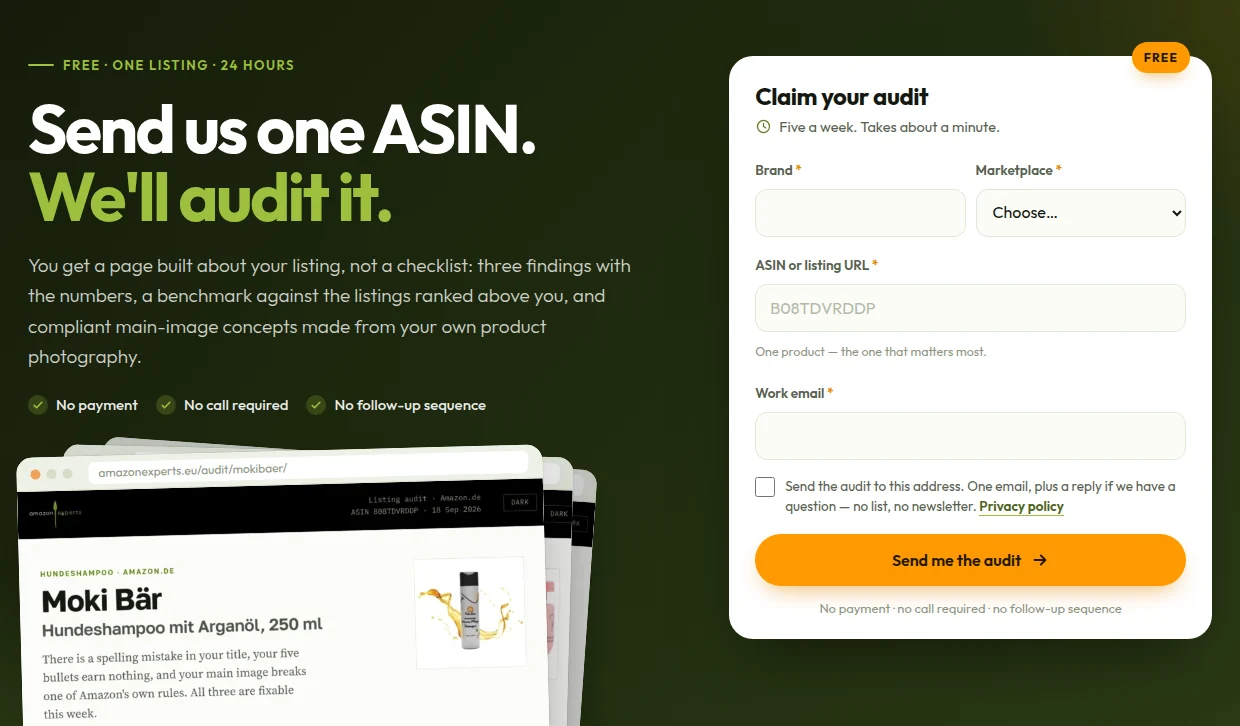
Closing it means picking the registrations that actually matter for your volumes, in the order that keeps your listings live, and not paying for the ones you do not need. Send us one ASIN and we will come back with a real audit — three findings with the numbers behind them, a content benchmark against whoever ranks above you, and main-image concepts built from your own photography.