Here’s how to launch on Amazon Germany without burning three months on a VAT hold or a listing nobody can read. Germany is Amazon’s largest marketplace in continental Europe, and the brands that do well there almost always get the sequence right: compliance first, account setup second, listings once the groundwork is actually done. Skip ahead and you end up fixing paperwork on a live account.
This playbook is built for US brand owners, operations leads, and finance leads who already sell steadily on Amazon.com and have decided to expand to Amazon Germany from the US as their first market in Europe. It doesn’t debate which country to pick, it walks through what to actually do once Germany is the answer.
Why Germany Rewards a Structured Launch
Germany generated $45.9 billion in Amazon net sales in 2025, the largest total outside the US and just ahead of the UK. That scale comes with scrutiny. German shoppers read full product descriptions before buying, Amazon enforces VAT compliance closely once inventory sits in a German fulfillment center, and machine-translated listings get buried fast by sellers who localized properly.
Sequencing solves most of this. Get registration, account linking, and localization done in the right order, and the rest of how to launch on Amazon Germany turns into straightforward execution.
Brands that treat a German launch like a bigger version of their US one tend to list first and sort compliance out later. That’s usually how a brand ends up with blocked inventory or a listing nobody can find in month two. The ones that sell on Amazon Germany successfully did the unglamorous compliance work quietly, before a single product went live.
The Step-by-Step Process to Launch on Amazon Germany
This is the sequence for how to launch on Amazon Germany, in order. Most launches that stall out did so because a brand jumped to listings before VAT and EORI were sorted.
Step 1: Confirm Product Fit and Demand in Germany
Check that your category actually sells in Germany at meaningful volume before anything else. Search local-language keywords, review competitor density on Amazon.de, and confirm your product isn’t subject to German-specific restrictions like CE marking or additional certification. A product that sells on branding alone in the US often needs to prove technical specs and durability to convert with German buyers, who read more of the listing before they buy.
Step 2: Register for VAT, EORI, and German Packaging Compliance (LUCID)
This is the compliance backbone of any Amazon Germany launch. None of what follows is tax or legal advice, work with a qualified accountant on your specific obligations before you commit inventory.
- German VAT registration can be triggered simply by storing inventory in Germany, that’s one of the clearest triggers for a non-EU business, and it can also come from cross-border sales once you pass distance-selling thresholds. Your exact obligation depends on your fulfillment model and where stock physically sits, so confirm it directly with your accountant. Timelines vary by case and tax authority and can run several weeks or longer, so start early.
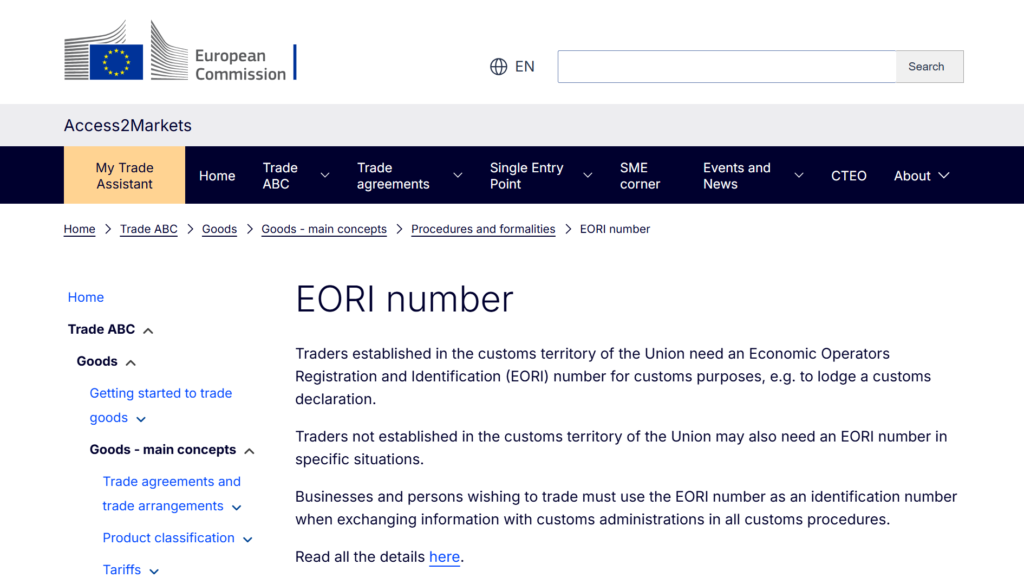
- An EORI number identifies your business to EU customs and is required to file a customs declaration for import or export activity. Non-EU businesses get one from the first EU member state where they conduct a customs operation. Without it, there’s no way to lodge the customs declarations needed to bring inventory into Germany.
- LUCID registration under Germany’s Packaging Act (VerpackG) applies the moment you place packaged goods on the German market, wherever your business is based. LUCID itself is the packaging register; registering is just the first step, most sellers also need a system participation agreement and volume reporting under the broader EPR framework.
- GPSR and CE marking sit on top of VAT, EORI, and LUCID for many product categories. Requirements shift by category, so check what applies to yours before finalizing inventory.
Handle this before account setup and you avoid the scramble of a live listing with no legal way to fulfill an order. This compliance checklist covering VAT, EPR, and GPSR walks through the full picture if you want it before locking in a launch date.
Step 3: Complete Your Amazon Germany Seller Account Setup
You don’t need a new Amazon account to launch on Amazon.de. Amazon Global Selling lets you link your existing account to the German marketplace directly in Seller Central, under the Global Selling section. Your account history comes with you, and Amazon confirms that in many cases, existing product reviews carry over to the new marketplace and get automatically translated.
Brand Registry is global by default, so there’s no re-registering it per marketplace. What you do need to build fresh as part of your Amazon Germany seller account setup is A+ Content, a Storefront, and Sponsored Brands campaigns, none of that inherits automatically the way Brand Registry does.
Step 4: Choose EFN or Pan-European FBA
This decision shapes your cost structure and VAT exposure for as long as you sell in Germany.
- EFN (European Fulfillment Network) keeps inventory concentrated in one country and ships across borders as orders come in. Because stock stays in one place, it can reduce the number of VAT registrations you need, though not eliminate them entirely, the exact count still depends on your sales and fulfillment structure. Delivery runs slower and costs more per order.
- Pan-European FBA spreads inventory across Amazon’s participating EU fulfillment centers, which speeds up delivery and lowers per-unit fees. It also creates a VAT obligation in every country where that stock physically sits.
Most brands testing Germany as a first market start with EFN to keep VAT complexity manageable, then move to Pan-EU once volume justifies the extra registrations. How many countries you plan to sell into in year one, and how much VAT complexity your finance team can absorb, usually settles the choice.
Step 5: Localize and List Your Products
This is where most botched German launches fail. Machine translation reads like machine translation, it misses the actual search terms German shoppers type, “kabellose Kopfhörer” for wireless earbuds, a literal rendering of the English phrase won’t surface at all. Bring in a native-speaking copywriter with ecommerce experience for your title, bullets, and backend keywords, and rebuild your A+ Content with the technical detail German buyers expect. A properly localized listing ranks; a translated one usually sits buried on page four.
For anyone researching how to launch on Amazon Germany and actually sell at volume, this step carries more weight than ad spend does in the first 60 days.
Step 6: Launch PPC and Build Your First Reviews
Every part of how to launch on Amazon Germany comes down to sequencing, and PPC is the one part you can’t front-load. Treat the first 30 to 60 days as a data-gathering phase. Your US ACOS benchmarks won’t mean much in a marketplace with zero reviews and no search history for your listing. Run broad-match campaigns to surface converting search terms, then narrow from there.
Once your first orders ship, use the Request a Review button in Seller Central within the eligible window, even a handful of early reviews moves click-through and conversion meaningfully on a brand-new German listing.
Common Mistakes US Brands Make Launching in Germany
Most guides on how to launch on Amazon Germany skip the mistakes that actually derail a launch. These show up most often:
- Skipping VAT and EORI until after the first sale. Amazon may restrict selling privileges without proof of compliance, and registrations started late routinely miss peak season entirely.
- Copy-pasting US backend keywords. The search volume for those exact terms usually doesn’t exist in German, so visibility stays at zero.
- Assuming Brand Registry alone means you’re ready. A+ Content, Storefronts, and Sponsored Brands still need setup for the German marketplace specifically.
- Launching in Germany and two other EU countries at once. Ad budget and localization attention split three ways usually produces three weak listings.
- Setting German PPC budgets from US ACOS benchmarks. A target that’s profitable on Amazon.com carries no signal in a marketplace with no reviews or search history yet.
Practical Launch Checklist
Work through this as your checklist for how to launch on Amazon Germany without missing a step:
- Confirm category demand and competitor density in Germany before committing inventory.
- Register for German VAT, EORI, and LUCID, and build in several weeks of buffer since timelines vary by case.
- Link your existing Amazon account to Amazon.de through Global Selling.
- Decide EFN vs Pan-European FBA based on your VAT readiness and delivery speed needs.
- Bring in professional native-language localization for titles, bullets, backend keywords, and A+ Content.
- Plan a 30-to-60-day PPC data-gathering phase before chasing US-style ACOS targets.
Conclusion
If you take one thing from this on how to launch on Amazon Germany, it’s that sequence beats speed. Get VAT, EORI, and LUCID sorted, link your account and pick a fulfillment model, and only localize and list once that compliance layer is genuinely done. Brands that jump straight to “get the listing live” tend to spend the next three months cleaning up what they skipped.
For a full pre-launch review specific to your product category, VAT setup, and fulfillment choice, Amazon Consulting can walk through this sequencing before you commit budget. If localization feels like the heaviest lift, building a professional listing for Amazon.de from the ground up is usually the highest-leverage place to bring in outside help.
Ready to launch on Amazon Germany but want a second set of eyes on VAT timelines, fulfillment choice, or your launch sequence before committing inventory? Book a free Amazon Europe expansion consultation and we’ll map out the specifics for your category.
1. Do I need a new Amazon seller account to sell in Germany?
No. You link your existing Amazon.com account to Amazon.de through Amazon Global Selling in Seller Central, and your account history and, in most cases, your product reviews carry over automatically.
2. How long does Amazon Germany VAT registration take?
Timelines vary by case and tax authority, and can run several weeks or longer. Start this before finalizing listings or shipping inventory, since Amazon may restrict selling privileges without proof of compliance. This isn’t tax advice, confirm your specific timeline with a qualified accountant.
3. What is an EORI number and do I need one?
It’s an identifier that links your business to EU customs for import and export activity. Non-EU businesses get one from the first EU country where they clear a customs transaction, and without it, goods can’t legally enter Germany.
4. Can I just translate my US listings for Amazon Germany?
Machine translation won’t get you ranked. It misses the actual German search terms shoppers use and reads awkwardly to buyers who expect polished, technical copy. A native-speaking ecommerce copywriter for titles, bullets, and backend keywords makes the difference.
5. Should I use EFN or Pan-European FBA to launch?
EFN keeps inventory in one country and limits how many VAT registrations you need, a reasonable starting point for a first EU launch. Pan-European FBA ships faster and costs less per order, but it creates VAT obligations everywhere your inventory sits.
Going into another EU country?
Packaging, batteries, electricals, product safety, cosmetics — each is a separate registration in each separate country, and Amazon switches the listing off where a number is missing. Answer three questions and see which ones apply to you. Free, no sign-up.
Check my registrations →