Selling on Amazon’s EU marketplaces from outside the EU can involve seven compliance checks: VAT registration where your stock is stored, an EORI number, GPSR Responsible Person details, packaging EPR, WEEE for electrical products, battery EPR and, for cosmetics, a Responsible Person plus CPNP notification. Missing one can get your offer deactivated in that country.
The newest, packaging EPR under the Packaging and Packaging Waste Regulation (PPWR), has applied since 12 August 2026. This Amazon Europe compliance checklist gives each check’s deadline, what happens if you miss it and what to do first.
The Amazon Europe Compliance Checklist at a Glance
Start with the table. If a row applies to your catalogue and you cannot point to the registration, notification or document that covers it, that row is your gap.
| # | Check | Who it applies to | Deadline if you launch now | If it is missing |
| 1 | VAT registration in each country where your stock is stored | Generally required for sellers holding inventory in that country | Before the first sale from stock stored in that country | Amazon may restrict selling in that country; the tax office can claim back-dated VAT, interest and penalties |
| 2 | EORI number | Businesses importing goods into the EU | Before your first shipment reaches EU customs | Customs clearance can be delayed or blocked, so stock does not reach the fulfilment centre |
| 3 | GPSR: manufacturer, EU Responsible Person and safety information on each listing | Most non-food consumer products | Before the listing goes live in each EU store | Amazon may deactivate affected offers for EU customers |
| 4 | Packaging EPR registration in each country where you have obligations | Producers of packaged goods, usually the seller when shipping direct from outside the EU | Before you sell into each of those countries | Amazon may deactivate offers in that country, or enrol you in Pay on Behalf where available |
| 5 | WEEE registration | Electrical and electronic equipment in scope | Before you list electrical products in that country | Amazon may deactivate offers where the number is missing |
| 6 | Battery EPR registration | Producers of batteries, including batteries built into products | Before you list battery products in that country | Amazon may stop the offer or enrol you in a paid comply-on-your-behalf service, depending on the country |
| 7 | Cosmetics: EU Responsible Person and CPNP notification | Cosmetic products sold in the EU | Before the product goes on sale in the EU | Amazon may request proof and remove the listing until it gets it; authorities can require corrective action |
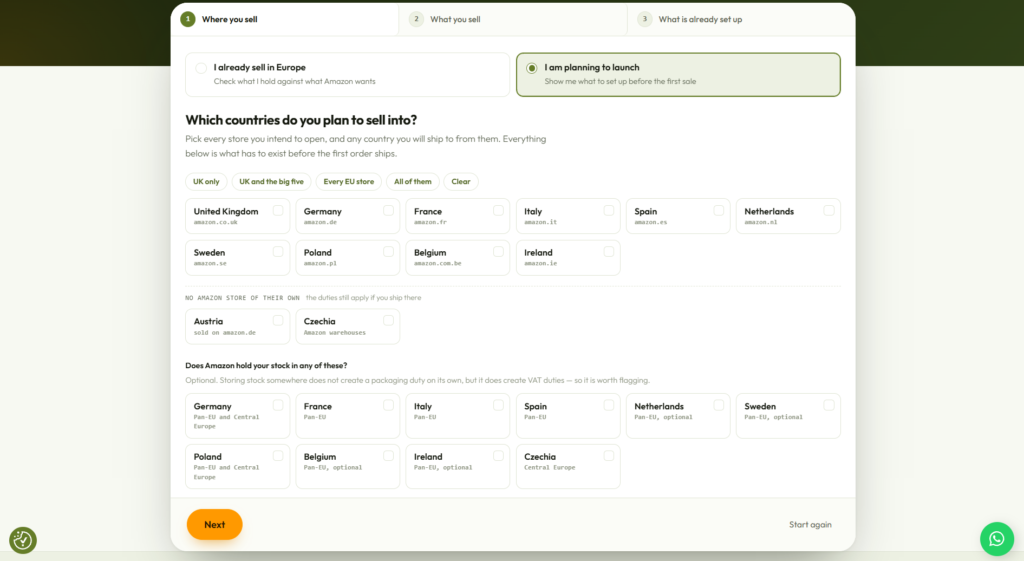
Not sure which rows apply to your products? Our free EU Compliance Checker asks three questions and returns a country-by-country list of the registrations Amazon expects from you.
The Seven Checks, One by One
Each item in this Amazon Europe compliance checklist follows the same pattern below: the key date or trigger, what happens when the item is missing, and the first action to take.
1. VAT Registration Where Your Stock Sits
Storing inventory in a country generally creates a VAT registration obligation there. The One-Stop-Shop (OSS) covers cross-border B2C sales, but it does not replace a local VAT number for stock held in that country.
- When: before the first sale from stock in that country. Amazon has required a German VAT ID from sellers holding stock in Germany since July 2021.
- If you miss it: Amazon may suspend your selling privileges for that country, and the tax office can claim back-dated VAT, interest and penalties. German law can hold marketplaces jointly liable for a seller’s unpaid VAT, which is why Amazon polices this closely.
- Do this: confirm which countries hold your stock using Seller Central’s inventory reports, then register in each one.
Pan-EU FBA can place inventory in Poland and Czechia as well as the larger marketplaces, and every new country adds a registration. Our guide on avoiding multiple VAT registrations compares EFN and Pan-EU, and Amazon Consulting can map your VAT footprint before you opt in.
2. EORI Number
An EORI number identifies your business to EU customs and is used for customs clearance, so it should be in place before goods arrive from outside the EU.
- When: before your first import shipment.
- If you miss it: customs clearance can be delayed or blocked. The stock does not reach the fulfilment centre and your listings sit at zero inventory.
- Do this: apply through the customs authority of the EU country where you first import.
3. GPSR: EU Responsible Person and Listing Safety Information
The General Product Safety Regulation (EU) 2023/988 has applied since 13 December 2024. For most non-food consumer products, a manufacturer based outside the EU needs a Responsible Person established in the EU. Amazon asks for the manufacturer’s and the Responsible Person’s details on each listing.
- When: 13 December 2024, already in force.
- If you miss it: Amazon may deactivate the offer for EU customers until the details and safety information are added.
- Do this: appoint an EU-established Responsible Person (the same one can generally cover your products across the EU), then add their details, warnings and safety information to each affected listing in every EU store you sell in, in that store’s language.
The warnings on the listing have to match the label on the product. A professional listing build keeps the listing, packaging and compliance fields consistent in every language, and our Amazon Europe product compliance guide covers GPSR labelling in detail.
4. Packaging EPR, Country by Country
Packaging EPR is registered country by country. A German LUCID number covers Germany only, and France, Spain, Italy and the other EU countries run their own registers.
Article 45 of the PPWR, Regulation (EU) 2025/40, requires online marketplaces to obtain your EPR registration for the member state where the customer is located, plus a self-certification of compliance, before letting you sell there.
Your own obligations follow where your packaging is first made available, which for a brand shipping directly to consumers from outside the EU generally means the countries it ships to. Where you are not established, you generally need an EPR authorised representative too.
- When: Germany since 1 July 2022; France since 1 January 2022; Spain since 1 January 2025; Amazon.it set 30 March 2026 for sellers not established in Italy. The PPWR has applied across the EU since 12 August 2026.
- If you miss it: it depends on the country. In Germany, Amazon deactivates the offer, and there is no Pay on Behalf option. In France, Spain and Italy, Amazon has enrolled sellers without a valid number in Pay on Behalf where available, but under the PPWR it must verify your own registration. Treat Pay on Behalf as a stopgap (from 1 January 2026 its service fee is €25 per EPR category per year, on top of the eco-contributions) and expect deactivation if the number stays missing.
- Do this: map the countries where you have packaging EPR obligations, register or appoint an authorised representative where required, then upload each number to the Compliance Portal in Seller Central.
5. WEEE Registration for Electrical Products
Products that run on mains power or batteries generally fall under WEEE rules, and WEEE is registered per country, like packaging.
- When: Germany from 1 July 2023; Italy from 31 December 2025 for 2025 sales; Spain phased in during 2025; France requires a UIN per EPR category, checked against the national SYDEREP register.
- If you miss it: listings for the affected products can be deactivated until a valid number is on file.
- Do this: register with Stiftung EAR in Germany, and with the national WEEE register in each other country where you sell electrical products.
6. Battery EPR Registration
The EU Batteries Regulation (EU) 2023/1542 applied its producer registration rules from 18 August 2025. They cover standalone batteries and batteries built into products, so a cordless hair trimmer or an LED vanity mirror counts.
- When: Amazon.it set 30 March 2026 for battery registration numbers.
- If you miss it: depending on the country, Amazon may stop selling the product or enrol you in a paid service that complies on your behalf.
- Do this: register in each member state where you make batteries available on the market for the first time. For a brand shipping directly to consumers from outside the EU, that generally means each country it ships to. Depending on the country, you register directly or through an approved producer responsibility organisation. A German WEEE number does not cover batteries.
7. Cosmetics: EU Responsible Person and CPNP Notification
Cosmetics run on their own law, Regulation (EC) No 1223/2009. Every cosmetic product needs a Responsible Person established in the EU, and that person must notify the product on the Cosmetic Products Notification Portal (CPNP) before it goes on the market.
- When: before the product goes on the market.
- If you miss it: Amazon can ask for CPNP proof and supporting documents, and may remove the listing until it receives them. National authorities can also require corrective action.
- Do this: confirm your Responsible Person has notified every cosmetic product you sell in the EU, and keep the product information file ready to send.
Claims cause as many beauty suppressions as missing paperwork. When we started on a premium body care brand’s Amazon UK account, our audit found listings that were occasionally suppressed over claims or ingredient documents. Keeping those documents in order and answering every compliance flag quickly brought compliance interruptions down to zero.
A suppressed listing also stops the ads pointing at it from serving, so the ranking you paid for slips while it is down. Our list of restricted keywords for cosmetics shows the phrases that trigger drug-claim flags.
Lead Time Is the Real Deadline
The dates in this Amazon Europe compliance checklist mark when requirements apply. Several registrations cannot start until another step is finished:
- VAT and EORI have to be in place before stock can move into an EU fulfilment centre.
- The CPNP notification is filed by your EU-established Responsible Person, so that appointment comes first.
- Packaging EPR in a country where you are not established generally needs an authorised representative before registration.
- GPSR listing fields cannot be completed until the Responsible Person is appointed.
Work in that order: VAT and EORI first, Responsible Persons second, EPR registrations third. Then upload every number to Seller Central before the listing goes live in each new country.
Common Mistakes That Leave Gaps in Your Amazon Europe Compliance Checklist
Most gaps come from assumptions that were true a year ago:
- Treating Pay on Behalf as compliance. It is a paid fallback offered in a few countries, and it does not remove your own obligations as a producer.
- Assuming one LUCID number covers the EU. It covers Germany only.
- Confusing the GPSR Responsible Person with the EPR authorised representative. They are separate roles, and a product safety mandate does not automatically cover packaging.
- Using OSS in place of a local VAT number where stock is physically stored.
- Letting Pan-EU FBA place stock in a country before VAT and EPR are registered there.
- Registering once and stopping. EPR schemes may also require recurring volume reports, declarations or fee payments, and the frequency varies by country and category.
If you would rather not track renewals and uploads yourself, Full Account Management keeps every registration on this Amazon Europe compliance checklist current across the marketplaces you sell in.
Conclusion
Run this Amazon Europe compliance checklist again before each new marketplace, each new product type and each time Pan-EU adds a storage country. For the detail behind each row, our Amazon EU compliance guide links every topic in one place.
If you want a second pair of eyes, book a free Amazon Europe compliance consultation and we will map which registrations your catalogue triggers, country by country.
FAQs
1. Do I need a VAT registration to sell on Amazon in Europe?
In most cases, yes. If Amazon stores your inventory in a country, you generally need a VAT registration there. The OSS scheme can cover VAT on cross-border sales to consumers in other EU countries, but it doesn’t replace local VAT numbers where your stock physically sits.
2. What is the EPR registration deadline under PPWR?
The PPWR has applied since 12 August 2026, so there is no grace period left. For a brand launching now, the deadline is before you sell into each country where you have packaging EPR obligations, because Amazon asks for the registration number for the customer’s country before letting you sell there.
3. What happens if I don’t have a valid EPR number on Amazon?
Amazon can deactivate your listings in the specific country where the registration is missing, sometimes without a grace period. In some markets, Amazon may also automatically enrol you in its Pay on Behalf program, which reports and pays your eco-contributions for an added service fee.
4. Do I need an EU Responsible Person under GPSR?
Yes, if you sell non-food consumer products in the EU. GPSR requires an EU Responsible Person’s name and contact details on file, and Amazon checks for this in the Compliance Information section before allowing certain listings to go live.
5. Does Amazon’s Pay on Behalf program cover my EPR compliance?
Only as a paid fallback, not a full solution. Pay on Behalf lets Amazon calculate and pay your packaging EPR contributions on your behalf, but it comes with an added service fee and doesn’t remove the requirement to eventually hold your own valid registration number in each country.
Which registrations does Amazon want from you?
Answer three questions and get a country-by-country list for the EU and UK — packaging, batteries, electricals, product safety, cosmetics. Free, no sign-up.
Check my registrations →