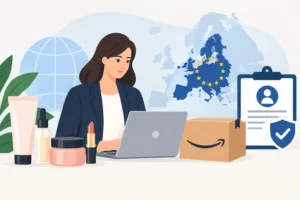
When Turkish beauty brands plan their first European move, the UK is often the instinctive choice. English-language content travels easily, British beauty culture has global visibility, and London feels like a natural launchpad. But that instinct was formed before Brexit restructured cross-border economics and before Germany quietly became one of the most attractive entry points in Europe for emerging beauty brands.
The Germany-first argument is compelling on almost every growth metric: market size, advertising costs, customer acquisition efficiency, and the ability to scale into 27 EU markets from a single setup. This article breaks down both markets so you can make the decision based on data, not default assumptions.
Germany Offers a Bigger and Less Saturated Beauty Opportunity
The market fundamentals alone make a strong case. Here is what brands will find when they look closely at Germany.
Germany’s Beauty Market Is Larger Than the UK’s
Germany is the largest beauty and personal care market in the EU, with total revenue reaching approximately €15.7 billion. The UK cosmetics and personal care market, by comparison, came in at $13.4 billion. In absolute terms, Germany offers more addressable revenue for Turkish beauty brands entering Europe for the first time.
Skincare is the fastest-growing category, fueled by an increasingly ingredient-conscious consumer base. The German clean beauty segment is projected to grow at a 16.8% CAGR through 2030, a direct match for the botanical and naturally-derived positioning that many Turkish beauty brands already carry.
Competition Is Lower Than in the UK
A lower level of competitive saturation compounds the size advantage. The UK’s DTC ecosystem has been building for over a decade; the German market absorbed the DTC wave later and less intensely. That gap is visible in the advertising landscape, influencer pricing, and how much effort it takes to earn a customer’s first purchase.
For brands that are new to Europe, Germany offers significantly more room to establish category presence before facing the density that defines the UK.
Lower Advertising Costs Make Germany More Profitable for New Brands
Market size and consumer fit only matter if a brand can acquire customers without burning through capital. On the paid media front, this is where the gap between Germany and the UK becomes most consequential for Turkish beauty brands.
Beauty Advertising Costs Are Significantly Lower in Germany
The cost of paid media in UK beauty is structurally higher than in Germany. Google CPC rates in the beauty category are meaningfully lower in Germany than in the UK — a gap that compounds quickly across a full acquisition funnel.
Meta CPM costs follow a similar pattern: UK beauty audiences are among the most contested in Europe. For brands working with constrained launch budgets, this difference is the variable that determines how many months of runway a campaign actually buys.
Germany Gives Smaller Brands a Longer Runway
Lower CPCs and CPMs translate directly into better ROAS and slower cash burn, two metrics that matter most during the testing phase. A Turkish beauty brand spending a fixed monthly budget in Germany will generate more impressions, more clicks, and more first-time purchases than the same spend produces in the UK.
That efficiency advantage is what allows brands to reach product-market fit with real data, rather than running out of capital before those answers arrive.
Germany Makes EU Expansion Easier Than the UK
The third major advantage of launching in Germany first is what comes next, and how smoothly a brand can move from one market to many.
EU OSS Simplifies VAT Across Europe
The EU One Stop Shop (OSS) scheme allows brands to register for VAT once in a single EU member state and sell across all 27 EU countries through a single quarterly return. Germany is a natural anchor for this setup: it is the EU’s largest economy, with strong infrastructure and a central geographic position.
Once the German operation is running, expanding into Austria, the Netherlands, France, and beyond requires no additional VAT registrations.
Post-Brexit UK Operations Are More Complex
The UK’s departure from the EU created a standalone regulatory environment that every cross-border seller must navigate separately. Selling into the UK from an EU base requires a separate UK VAT registration, separate customs documentation, and compliance with UKCA regulations that no longer align with EU standards.
For Turkish beauty brands already managing customs when exporting from Turkey into the EU, adding a second distinct compliance regime for the UK compounds that complexity at a stage when operational simplicity has real value.
Many Turkish Beauty Brands Use Bulgaria to Fulfil Germany Efficiently
A practical logistics option that many Turkish e-commerce brands have adopted is using Bulgaria as their EU fulfilment hub. Bulgaria is an EU member state, meaning goods cleared through Bulgarian customs move freely across the EU. Warehouse costs are significantly lower than in Western Europe, and transit times to Germany are competitive.
This setup allows brands to offer fast, EU-standard delivery to German customers at a cost structure difficult to replicate from a UK warehouse, and the same infrastructure scales to France, Poland, and Spain as the business grows.
When a UK-First Strategy Still Makes Sense
Germany is the stronger default for most Turkish beauty brand, but the right choice depends on what a brand has already built.
Brands with Strong English-Language Positioning
If a brand has been built around English-language content, founder storytelling, social media presence, or brand identity that does not translate easily, the UK may be the natural starting point. Genuine localisation for Germany takes time and cultural investment that not every brand is ready for at launch.
Existing UK Audiences or Retail Partnerships
If a brand has already generated meaningful UK traction through press coverage, influencer partnerships, or a retail conversation in progress, that demonstrated demand is worth following. Entering a market toward existing interest is always more efficient than building from zero.
Premium Brands Targeting Global DTC Expansion
London retains real influence as a global beauty capital. For luxury-positioned brands whose strategy is to build international brand equity before optimising for volume, UK presence can accelerate positioning in ways Germany does not replicate, provided the brand and budget match the ambition.
If the answer for your brand is UK first, the next decision is who runs the account day to day. Here is how we work as an Amazon agency in the UK, and here is an honest comparison of the agencies that work with beauty and cosmetics brands.
Choosing the market is the first decision; running it well is the longer one. That is our work as an Amazon agency for beauty and cosmetics brands.
Conclusion
For most Turkish beauty brands planning their first European market entry, Germany is the more rational choice. Lower CAC, better ROAS potential, simpler VAT compliance through EU OSS, and a consumer base that rewards quality over hype, all of these compound in favor of a Germany-first launch.
The UK is not a bad market. But it rewards brands that arrive with established budgets and proven product-market fit. Most are better served by building that foundation in Germany first, reaching profitability faster, and entering the UK from a position of strength.
Start in Germany. Scale across the EU. Then decide whether the UK belongs in your roadmap, and on what terms.
1. Is Germany better than the UK for first-time EU expansion?
Yes. Germany offers lower customer acquisition costs, easier EU-wide expansion through OSS VAT, and a larger beauty market than the UK.
2. Why do Turkish beauty brands often choose Germany first?
Many Turkish beauty brands choose Germany because advertising is cheaper, competition is lower, and Germany provides easier access to the wider EU market.
3. When does a UK-first strategy make sense?
A UK-first strategy works best for brands with strong English-language branding, existing UK audiences, or premium positioning focused on global visibility.
Going into another EU country?
Packaging, batteries, electricals, product safety, cosmetics — each is a separate registration in each separate country, and Amazon switches the listing off where a number is missing. Answer three questions and see which ones apply to you. Free, no sign-up.
Check my registrations →