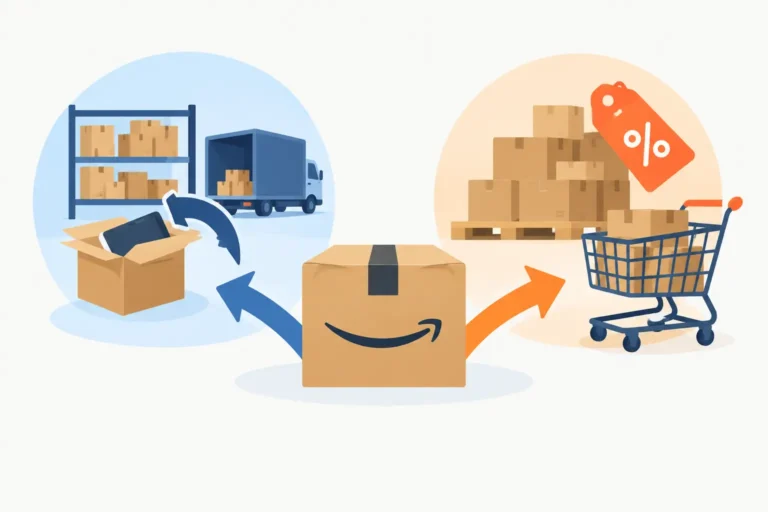
Amazon is ranked #4 among the most valuable brands worldwide. The global e-commerce giant achieved nearly USD 638 billion in net sales worldwide in 2024. Along with Amazon 1P, 3P, and the increasingly popular hybrid model, brands today have multiple ways to sell on Amazon. 1P vs. 3P vs. hybrid represents important strategic choices for manufacturers and businesses.
Amazon 1P Model (Amazon Vendor)
Amazon Vendor (1P) is a relationship model where the manufacturer or brand owner sells its products directly to Amazon.
In this model, Amazon purchases inventory from the vendor at wholesale prices and then resells it to end consumers on the Amazon marketplace.
The 1P model is invitation-only. Amazon extends an offer to selected brands or manufacturers it deems suitable for retail partnership. Once invited, the vendor must review and accept Amazon’s Vendor Agreement.
The core mechanic of 1P is the Purchase Order (PO).
Instead of receiving individual customer orders, the vendor waits for Amazon to send an electronic Purchase Order (PO) detailing the specific products and quantities Amazon wants to buy. The vendor then ships the product to an Amazon fulfillment center, and Amazon takes ownership of the inventory.
The vendor’s primary function is to fulfill the POs on time and according to Amazon’s compliance guidelines (packaging, labeling, delivery windows).
Vendors manage their business relationship with Amazon through Vendor Central.
Amazon 3P Model (Amazon Seller)
The Amazon Seller (3P) model allows manufacturers, brand owners, and independent sellers to list and sell their products directly to consumers on Amazon’s global marketplace. The seller retains ownership of the inventory until the product is sold and shipped to the customer.
This is the more common and accessible selling model.
Unlike the invitation-only 1P model, the 3P model is an open marketplace. Virtually any individual or business can sign up to become an Amazon Seller, provided they pass standard identity verification and agree to Amazon’s terms of service.
(Source: Amazon)
To participate, simply create an account through Seller Central. Registration can be completed with basic business information.
In Amazon Seller Central, sellers can list and manage products across multiple categories and marketplaces, set pricing, monitor inventory, track sales performance, and handle customer service (for FBM sellers) as well as manage returns.
Amazon offers two primary fulfillment pathways under the 3P model: FBA and FBM. In short, in FBA (Fulfillment by Amazon), sellers ship products to Amazon, which manages storage, shipping, customer service, and returns. In FBM (Fulfillment by Merchant), sellers manage storage, packaging, shipping, and customer service themselves.
The 3P model is the most common entry point for new brands, small businesses, and manufacturers launching products on Amazon.
Sellers have the option to choose between two main plans: the Individual Plan, which incurs a $0.99 fee per item sold, and the Professional Plan, which features a monthly subscription fee of $39.99 (subject to change) and variable closing fees.
The Hybrid Model
The hybrid approach is a strategic decision where a brand utilizes both Amazon Vendor (1P) and Amazon Seller (3P) to manage its presence on Amazon.
In particular, the brand sells some products wholesale to Amazon (1P) while also selling other products directly to consumers (3P).
Pros of the Hybrid Model on Amazon
Scale and Control
The hybrid strategy enables brands to benefit from the wholesale stability and operational simplicity of 1P, while also achieving the profit margins and pricing control of 3P.
Flexibility
The manufacturer is not bound by a single set of rules or a fixed margin structure. They can decide on a product-by-product basis whether they value the high volume of a wholesale PO (1P) or the high margins and control of a retail sale (3P).
Diversification and Risk Reduction
By operating across both platforms, brands reduce dependency on a single Amazon sales channel.
If the Amazon algorithm reduces or postpones 1P Purchase Orders (POs), the 3P channel guarantees ongoing product availability and sales movement. Likewise, if there are operational challenges or pricing pressures in 3P, 1P bulk sales offer a source of stability.
Pricing Control and Profitability
The manufacturer can use the 3P channel to set a high, stable retail price on their hero products, protecting their brand’s value (and the prices of their brick-and-mortar retail partners).
Subsequently, they can employ the 1P channel for items that are highly competitive, allowing Amazon’s aggressive pricing strategy to seize market share without directly associating the lower price with the manufacturer’s name.
Cons of the Hybrid Model on Amazon
Operational Complexity
Handling both Vendor Central and Seller Central at the same time creates considerable operational challenges. Brands need to uphold distinct operational procedures for logistics, invoicing, pricing, and reporting.
Resource Intensive
Running both models effectively requires dedicated resources. Brands often need to invest in:
- Specialized personnel (for PO management, pricing control, and listing optimization).
- Automation tools or agencies to manage listings, inventory sync, and performance monitoring across both channels.
Internal Conflict & Policy Risks
Amazon generally prohibits or strongly discourages selling the same product (ASIN) through both 1P and 3P simultaneously, as it creates internal competition:
- Pricing wars: The 1P (Amazon Retail) price and the 3P (Your Seller Account) price will compete against each other, potentially driving the final retail price to an unsustainably low level.
- Policy violation: Attempting to sell the same product across both accounts can confuse Amazon’s system and may lead to suppressed listings or other punitive actions by Amazon. The brand must be strict about channel separation for each ASIN.
1P vs. 3P vs. Hybrid: Which One is the Best Model for Your Brand?
The ideal option depends on what your brand values most.
The 1P model is ideal for:
- Major brands that have a robust supply chain framework in place for wholesale distribution.
- Low-margin or commodity products: Items where higher sales volume is more crucial than individual profit margins, and where matching prices is not a significant issue.
- Brands that emphasize reliability: Products where the “Sold by Amazon” label is essential for building consumer trust (such as electronics and major appliances).
- Teams with limited resources for e-commerce: Brands that prefer Amazon to fully handle the retail, fulfillment, and customer service responsibilities.
The 3P model is ideally suited for:
- New or private-label brands.
- High-margin or niche products: Items that require the brand to enforce a strict Minimum Advertised Price (MAP) policy in order to safeguard relationships with physical stores and overall brand integrity.
- Flexible fulfillment: Brands that wish to leverage FBM.
The Hybrid Model is the most sophisticated and resource-intensive, but it offers the most significant long-term advantage for large brands that are already successful in the 1P channel. This model is best suited for:
- Diversified catalogs: Brands with a wide range of products.
- New product introduction: Launching new SKUs on 3P enables the brand to fine-tune content, advertising, and pricing until sales velocity is proven, and then offer it to Amazon as a 1P wholesale item.
- Risk management: Brands that need a reliable backup plan. If Amazon’s 1P algorithm fails to order an essential product, the brand can use its 3P account to fulfill orders and prevent stock shortages.
Choosing the model is one decision; running it profitably is the longer one. See our Amazon Vendor Central management work.
Choosing between 1P, 3P and hybrid is the single decision with the longest tail. We work through it with brands as part of Amazon consulting.
Pros and Cons of the Amazon 1P Model
Selling as a vendor turns the brand into a wholesale supplier, while Amazon takes on the role of retailer. The arrangement brings real advantages, but it also hands Amazon a large share of the decisions.
Pros of the 1P Model on Amazon
“Sold by Amazon” Trust
Products listed as shipped and sold by Amazon carry the retailer’s own reputation. For many shoppers, especially in electronics, appliances, and other higher-ticket categories, that label removes hesitation at the point of purchase.
Simpler Day-to-Day Operations
The vendor’s main duty is to supply stock in bulk against Amazon’s POs. Storage, shipping, customer service, and returns all sit with Amazon.
Large, Predictable Order Volumes
Amazon orders according to its own demand forecasts. A healthy 1P relationship can therefore deliver large POs and a steady revenue stream that is easier to plan production around.
Automatic Prime Eligibility
Because Amazon owns and ships the inventory, 1P products are typically Prime-eligible without the brand having to enroll in FBA. The Prime badge remains one of the strongest conversion drivers on the marketplace.
Retail-Side Marketing Support
Vendors work directly with Amazon’s retail team and can use Vendor Central’s content and advertising tools, including A+ Content, without running a separate Seller Central operation.
Cons of the 1P Model on Amazon
Loss of Pricing Control
Once Amazon owns the stock, Amazon sets the retail price. If its pricing system finds a lower price elsewhere, it may match it, even below the brand’s Minimum Advertised Price (MAP). This can strain relationships with other retail partners who are held to that MAP.
Thinner Margins
1P runs on wholesale pricing. The brand sells to Amazon at a lower rate than the shopper pays, which leaves less profit per unit than selling directly through 3P.
Compliance Standards and Chargebacks
Amazon sets strict requirements for labeling, packaging, shipment notifications, and delivery windows. Late shipments, incorrect barcodes, or carton errors can trigger chargebacks that are deducted from what Amazon owes the vendor.
Slow Payment Terms
Vendors are paid on contract terms such as Net 30, Net 60, or Net 90. Between producing the goods and receiving payment, a large PO can tie up cash for months.
Limited Access
Vendor Central is invitation-only. A brand cannot simply apply, so 1P is not a model that a launch plan can rely on.
Pros and Cons of the Amazon 3P Model
As a seller, the brand keeps ownership of its stock and sells directly to shoppers, with Amazon acting as the marketplace. The model is open to almost anyone, but the brand carries more of the work and more of the risk.
Pros of the 3P Model on Amazon
Access to Amazon’s Traffic
A seller account puts the brand’s listings in front of the same base of active buyers that Amazon’s own retail business serves, from the first day.
Pricing and Content Control
Sellers set their own prices, run their own promotions, and decide what goes into titles, images, and A+ Content (with Brand Registry). This makes it far easier to protect MAP and keep the Amazon presence consistent with other sales channels.
Outsourced Logistics Through FBA
With FBA, storage, shipping, customer service, and returns can be handed over to Amazon, so even a small team can offer fast delivery. FBA products also qualify for Prime automatically.
Easier International Expansion
Amazon’s infrastructure across Europe, North America, and Asia makes opening new marketplaces significantly simpler than building traditional retail distribution country by country.
Scalability
The tools, systems, and fulfillment capacity are already in place, so a brand can grow its catalog and volume without building that infrastructure itself.
Cons of the 3P Model on Amazon
Layered Fees
Selling costs come from several directions at once: a referral fee on each sale (a percentage of the total sale price that varies by category), the monthly Professional subscription or the per-item fee on the Individual plan, closing fees on media items, and FBA fulfillment and storage fees for brands using Amazon’s logistics.
Intense Competition
Sellers compete with other third-party sellers, established brands, and Amazon’s own private-label products. In crowded categories, that pressure quickly shows up in pricing and advertising costs.
Limited Brand Presentation
Listings follow Amazon’s templates, and FBA orders ship in Amazon packaging. There is little room to stand out through packaging or the unboxing experience.
Policy Enforcement and Suspensions
Much of Amazon’s enforcement is automated. Listings can be removed or accounts suspended over relatively minor policy issues, and reinstatement is often slow.
1P vs. 3P: Key Differences at a Glance
Placed side by side, the two models differ on five practical points:
- Sales model: In 1P, the brand sells wholesale to Amazon (B2B), and Amazon resells to shoppers. In 3P, the brand sells directly to shoppers on the marketplace.
- Pricing control: In 1P, Amazon sets the final retail price. In 3P, the brand sets its own prices and discounts.
- Fulfillment: In 1P, Amazon handles fulfillment, shipping, and customer service once the PO is delivered. In 3P, the brand chooses between FBA and FBM.
- Marketing tools: 1P brands work through Vendor Central’s content and advertising tools. 3P brands need Brand Registry to unlock A+ Content and Brand Stores, alongside Sponsored Ads.
- Payment terms: 1P vendors are paid on contract terms such as Net 30, 60, or 90. 3P sellers usually receive payouts every two weeks after the customer buys.
How Costs Compare Across 1P, 3P, and Hybrid
Amazon’s fees rarely look alarming at the start, but over time they decide which model is actually profitable. Each model charges the brand in a different way.
3P Costs
The cost lines are visible, but they accumulate quickly. Referral fees in most categories fall roughly between 8% and 15% of the sale price. FBA adds fulfillment and storage fees that depend on product size, weight, and season. Then there is PPC: technically optional, but in practice most brands need it to stay visible. The brand carries the full advertising risk, but because every cost line is reported, pricing, ads, and inventory can be optimized over time.
1P Costs
There is no simple fee list. Costs are built into the wholesale price and into deductions such as chargebacks, co-op and marketing allowances, and early payment discounts. Margins that look acceptable when terms are agreed often shrink once these deductions are applied, and it is harder to see exactly how Amazon arrives at final profitability. Large PO volumes can offset thinner margins, but only for brands with strong cost control and enough cash flow to absorb long payment terms.
Hybrid Costs
A hybrid brand runs both cost structures side by side: 3P where margin matters most, 1P where volume and efficiency matter more. Tracked carefully, this mix often gives the best long-term cost control. Tracked loosely, it becomes difficult to tell which channel is actually making money.
A Five-Step Framework for Choosing Your Model
For brands that are still undecided, these five steps turn the choice into a structured decision. They are particularly useful for brands coming from Shopify or another direct-to-consumer (DTC) channel, where full control over price and content is the norm.
Step 1: Assess Your Control Needs
If setting your own prices and controlling titles, images, and content updates is non-negotiable, 3P is the natural fit. In 1P, Amazon controls pricing, promotions, and sometimes how the product is positioned, which can clash with a DTC mindset. Hybrid keeps control where it matters most and lets Amazon handle the rest.
Step 2: Evaluate Your Supply Chain
Is production stable? Can inventory be forecast with confidence? Can the business handle large, sudden orders? If not, 3P is safer, because restocking follows actual demand. 1P requires the discipline to meet large POs on strict timelines, and missed deliveries damage the relationship.
Step 3: Set Your Financial Priorities
Look beyond revenue to margins and cash flow. 3P usually delivers higher margins but carries ad spend and inventory risk. 1P offers larger, steadier volumes at thinner margins and with slower payment. Hybrid protects margins on key SKUs while using 1P to scale volume.
Step 4: Match the Model to Each Product Type
High-margin, brand-defining products usually perform best under 3P, where price and brand image are protected. High-volume, price-sensitive products often suit 1P, where Amazon is strong at driving scale. In a hybrid catalog, every SKU should have a deliberate role.
Step 5: Test and Measure
Start with a small number of SKUs and track margins, ad spend, sales velocity, and operational workload. After 60 to 90 days, clear patterns usually emerge, and the next move can be based on data rather than assumptions.
How Brands Move Between Models as They Grow
The choice of model is rarely permanent. Many brands follow a similar path:
- Early stage: Small and growing brands usually start as 3P sellers. Control over pricing, listings, and ads matters most while demand is still being tested, and a handful of SKUs can be adjusted quickly without large commitments.
- Established sales: Once a brand has steady sales and a reliable supply chain, hybrid starts to make sense. High-margin products stay in 3P, while high-volume SKUs move to 1P for scale.
- Enterprise scale: Large brands with strong production, logistics, and cash flow can make 1P a core channel, accepting less control in exchange for efficiency at volume.
Strong 3P performance is also one of the most common routes into Vendor Central. Brands that build sales history and brand awareness as sellers are the ones most likely to receive an invitation, either for the full catalog or for selected products.
Even after a brand is established in 1P, the seller account remains useful. It can absorb surplus stock that Amazon does not reorder and handle complex or customizable products that need closer contact with the customer.
Conclusion
You can achieve success with any of the selling models on Amazon. So, which model is superior: 1P, 3P, or Hybrid? The response varies based on your brand’s objectives and available resources.
FAQs
1. Is 1P or 3P more profitable for Amazon?
The Amazon 3P model is generally more profitable on a margin basis. 1P generates higher gross revenue, 3P generates higher-margin service revenue for Amazon. Third-party sellers now account for over 60% of all paid units sold on Amazon’s marketplace, based on a Statista report.
2. How much is Amazon 3P?
Amazon sellers have the option to choose between two main plans: the Individual Plan, which incurs a $0.99 fee per item sold, and the Professional Plan, which features a monthly subscription fee of $39.99 and variable closing fees.
3. How to become a 1P seller on Amazon?
Becoming an Amazon Vendor (1P) is an invite-only process. You must be invited by Amazon to join. The primary step is to build a successful and attractive brand that Amazon will want to partner with.
4. Is Amazon Seller Central 3P?
Amazon Seller Central is a platform that 3P sellers use to handle all elements of their business, including product listings, inventory, pricing, orders, and advertising. Third-party sellers are independent businesses or individuals who sell their products directly to customers on Amazon through the Amazon Marketplace.
5. Can a normal person sell on Amazon?
To participate, simply create an Amazon selling account for free. There are specific fees associated with selling on the platform. Amazon provides two primary selling options: the Individual plan (0.99foreachitemsold) and the Professional plan (39.99 per month, regardless of the number of sales).