GPSR, the EU’s General Product Safety Regulation, took effect on December 13, 2024, and Amazon has built it directly into how EU listings work. Sellers now need to submit Responsible Person and manufacturer information for affected products through Seller Central, and Amazon removes non-compliant offers when that information is missing or incomplete.
For US brand owners and ops leads planning to sell on Amazon Germany, France, or any other EU marketplace, that’s the core of Amazon Europe product compliance: sorting out labeling, safety documentation, and Responsible Person details before you launch, rather than scrambling once a listing gets flagged. Here’s what GPSR, labeling, and safety rules actually require from you.
Why Amazon Europe Compliance Can’t Wait Until After Launch
National authorities across the EU and EEA notified 4,671 Safety Gate alerts for dangerous non-food products in 2025, a 13% increase from 2024, and more than double the number reported in 2022. Cosmetics, toys, and electrical appliances and equipment were the most frequently reported categories, together accounting for more than half of all notifications.
Amazon has built GPSR compliance requirements into Seller Central, where sellers submit and manage Responsible Person and manufacturer information for affected products. Non-compliant offers get removed, Amazon has already pulled listings that were missing this information since GPSR took effect, and reinstating a suspended listing means resubmitting the correct documentation before Amazon will republish it. Losing a listing while you sort out paperwork means losing sales and ranking at the same time.
That’s why Amazon Europe product compliance works best as part of the market-entry plan itself, alongside VAT and fulfillment decisions, rather than something you circle back to after the first shipment lands.
It’s also a moving target: GPSR only took effect at the end of 2024, and EU packaging rules under PPWR are still rolling out, so a setup that cleared review last year might not clear it this year without a fresh look. If you’re still mapping out the broader European launch, market sequencing, VAT, fulfillment model, our guide to expanding an Amazon brand to Europe covers that groundwork; this piece stays focused on the product and label side.
What GPSR Requires From US Sellers on Amazon Europe
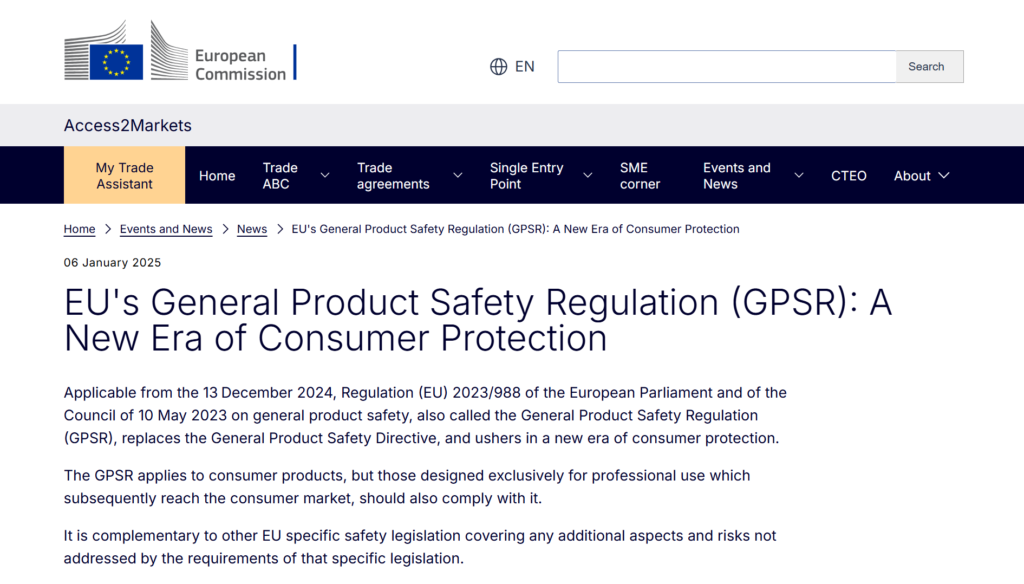
Amazon GPSR requirements break down into two practical questions once you get past the acronym: who represents your brand inside the EU, and what does your label actually have to say. Between the two, they cover most of what regulators check when they review a listing for Amazon Europe product compliance.
Appointing an EU Responsible Person
Most non-food consumer products covered by GPSR need a named Responsible Person based inside the EU, the legal contact regulators and Amazon go to if something goes wrong with the product after it’s sold. You can fill the role a few ways:
- A dedicated compliance service provider based in the EU
- Your own EU-based entity, if you have one
- An EU-based distributor or importer willing to take it on
The role stays active for as long as the product stays listed, so it’s closer to an ongoing relationship than a one-time signature. You submit the details of the EU Responsible Person Amazon requires through the Manage Your Compliance dashboard in Seller Central, and Amazon can remove or restrict listings that don’t meet this requirement.
If you add a new variant or bundle, it’s worth reviewing separately to confirm its product, manufacturer, and Responsible Person information is accurate and properly reflected in Seller Central, don’t assume it automatically inherits compliance status from an existing listing.
What Must Appear on Your Product Label
Amazon EU labeling requirements mean the information on your product, packaging, and Amazon listing needs to be consistent and accurate. At minimum, GPSR requires:
- Manufacturer name, postal address, and electronic address
- Responsible Person’s name, postal address, and electronic address
- A product identifier, model, batch, or serial number
- Warning and safety information in the language of the country you’re selling into
For very small items like jewelry or cosmetic samples, this information can sit on the packaging or an accompanying document instead of the product itself, the point is that a buyer needs to be able to find it, not that it has to fit on a tiny surface. Where sellers usually trip up is copy drift: they update the listing text but forget the physical label, and the mismatch is one of the more common reasons a product gets pulled for review.
Beyond GPSR: EPR, Packaging and Safety Claims
GPSR handles product safety and labeling, but two other compliance layers tend to catch US brands off guard.
Packaging (EPR) Registration
Extended Producer Responsibility, or EPR, is a separate obligation from GPSR that deals with what happens to your packaging after a customer opens the box.
Germany was the first EU country to enforce this through Amazon directly, sellers need a valid LUCID registration number on file, or Amazon blocks the listing from selling into Germany, and other EU countries now run comparable national schemes for packaging, electronics, and batteries. If your product touches any of those categories, that’s the EPR compliance Amazon expects on top of your GPSR paperwork, a country-by-country task with its own fees and reporting cycles to budget for.
Marketing and Safety Claims
Marketing and safety claims need to be accurate and properly substantiated too. Claims like “hypoallergenic,” “dermatologist tested,” or “BPA-free” can create additional compliance obligations depending on the product category and the specific rules that apply to that claim, separate from GPSR’s own risk-assessment requirements for the physical product.
An unsupported claim can still create regulatory and marketplace-compliance issues, even when the product itself doesn’t present an obvious safety defect. Beauty, FMCG, and baby-product brands run into this most often, since those categories draw close regulatory attention.
Common Amazon Europe Compliance Mistakes US Brands Make
A few patterns show up again and again with US brands moving into Europe:
- Treating GPSR as a one-time task rather than a per-SKU check, so a new variant or bundle gets copy-pasted from an existing listing instead of its own review
- Assuming a US test report or certification automatically satisfies EU requirements, when EU standards often test for different risks or use different thresholds entirely
- Putting the Responsible Person’s details in the product description but leaving them off the physical label, or the reverse
- Skipping EPR registration because GPSR is already sorted, on the assumption one covers the other
- Only looking into Amazon Europe product compliance once a listing has already been suspended, rather than building it into the launch timeline
- Assuming a compliance provider’s submission is enough on its own, without verifying the same information is correctly reflected in Amazon Seller Central too
These line up with the same failure points we flagged in our breakdown of 9 Amazon Europe expansion mistakes, compliance gaps tend to show up alongside VAT and fulfillment missteps, because they all come from treating the EU launch like a copy of the US listing process. Most of them get caught the same way: going through the product and label requirements above, SKU by SKU, before a listing goes live rather than after Amazon flags it.
Conclusion
Compliance won’t slow down your launch if you build it into the timeline from the start, sitting right alongside VAT and fulfillment decisions instead of getting added on afterward. A short GPSR compliance checklist next to your launch plan is usually enough to avoid the scramble later. Revisit it whenever you add a SKU, change a supplier, or expand into a new EU marketplace, since any of those can shift what’s required. Our Amazon Consulting team handles this cross-check, mapping GPSR, EPR, and labeling requirements against your catalog before you ship into the EU.
Want a second set of eyes on your Amazon Europe product compliance setup before you launch? Book a free compliance check and we’ll go through your catalog together.
FAQ
1. Do US sellers need an EU Responsible Person to sell on Amazon in Europe?
Yes. Most non-EU brands selling non-food consumer products covered by GPSR need a Responsible Person based in the EU, and Amazon requires this information in Manage Your Compliance before certain listings can stay live. It’s the starting point of Amazon Europe product compliance for any non-EU brand.
2. What information must appear on a GPSR-compliant product label?
At minimum: manufacturer name with postal and electronic address, Responsible Person contact details, also including a postal and electronic address, a product identifier like a batch or model number, and safety warnings in the local language. This information needs to be consistent with your Amazon listing too.
3. What happens if my Amazon EU listing isn’t GPSR compliant?
Amazon can remove or restrict listings that don’t meet GPSR information requirements, and national market surveillance authorities can separately flag the product through the Safety Gate system, which can lead to further action on future shipments. Getting a suspended listing back usually means submitting corrected label files and documentation through Seller Central for Amazon to review.
4. Is GPSR compliance the same as CE marking?
No. CE marking covers specific product categories under separate EU legislation, while GPSR is a broader safety and labeling requirement that applies to most non-food consumer products, including plenty that don’t need CE marking at all.
5. Do US brands need EPR registration in addition to GPSR?
Yes, if the product involves packaging, electronics, or batteries. EPR runs through country-specific schemes rather than a single EU-wide system, so it sits alongside GPSR rather than inside it.