Start with Germany or the UK, unless your product fits somewhere else better. For most US brands, Germany is the right first EU market: it’s the largest Amazon store in continental Europe and the natural hub for shipping to neighboring countries. If you’d rather launch without translating anything, the UK is the easier start.
But the biggest market isn’t always the best fit. When we took Men’s Master, a men’s face cream we manage, beyond the UK, we chose Spain over Germany. Spain now sells 15,000 units a year, three times the UK.
Whichever market you pick, the cost to expand Amazon brand to Europe comes down to four things: a selling plan, VAT and EPR registrations, local-language listings, and product compliance. The table below shows when each market is the right call and what it takes to enter.
Which Amazon Europe marketplace to start with
| Market | When it is right | What it costs to enter |
| UK (amazon.co.uk) | You want to test Europe in English, with no translation. | Professional plan £25/month; UK VAT (20%) if you store stock there; UK packaging EPR; UK-specific product compliance, separate from the EU. |
| Germany (amazon.de) | You want the largest EU market and one hub to ship the rest of the EU from. | Professional plan €39/month, covering all EU stores; German VAT (19%); a LUCID packaging number before your first sale; German listings. |
| Spain (amazon.es) | Your category is crowded in Germany but still has room in Spain. Check page-one competition in both before you decide. | Spanish VAT (21%) if you store stock there; Spanish packaging EPR; Spanish listings. |
| France (amazon.fr) | Your second EU market, once Germany runs and you can serve France from German stock. | French VAT (20%) if you store stock there; a French EPR unique ID (IDU) for each EPR stream that applies (packaging, electronics and so on), plus the Triman recycling label; French listings. |
| Italy (amazon.it) | Same logic as France: add it from German stock once the listings are localized. | Italian VAT (22%) if you store stock there; packaging EPR obligations through CONAI, usually handled by an Italian representative; Italian listings. |
| Netherlands, Poland, Sweden, Belgium | Low-cost additions once the core markets run, mostly served cross-border. | Packaging EPR in each country you sell into; local listings; VAT registration only where you store stock. |
One rule now applies to every row: since 12 August 2026, the EU’s new packaging regulation (PPWR) requires marketplaces like Amazon to hold your packaging EPR registration for the shopper’s country before letting you sell there, and Amazon’s checks now reach beyond Germany and France. If you ship your own packaged products to shoppers in a country, you are usually the producer there and need that country’s registration; a German LUCID number does not cover France or Spain.
Not sure which market fits your product? Send us one ASIN and we’ll tell you where we’d launch it first.
If you sell cosmetics
Before listing in any EU store you need an EU-based Responsible Person and a CPNP notification. Great Britain needs its own UK-based Responsible Person and a separate SCPN notification. Both notifications are free; the Responsible Person service is not.
Step 1: Set Up Your Amazon Global Selling Account
If you already sell on Amazon.com, you don’t start from scratch. Amazon Global Selling lets you open a regional Europe account in Seller Central, and in many cases your existing reviews carry over and get translated automatically.
Apply for an EORI number in the first country where you’ll file customs declarations; you need it to import goods into the EU. Then use Build International Listings to push your catalog into each store under the same SKUs, so inventory and pricing stay in sync.
Step 2: Register for VAT and EPR before you ship
This is where most US brands lose time. Get it wrong and Amazon deactivates listings until the numbers are in Seller Central.
VAT: where you register and who collects it
Store inventory in a country and you generally need a VAT number there, so every warehouse country means a registration. The sales side is simpler for a US business with no EU entity: when Amazon sells your EU stock to consumers, Amazon acts as the deemed supplier and collects and pays the VAT itself. The UK works the same way for overseas sellers. That doesn’t remove the registration where your stock sits. The One-Stop-Shop (OSS) mostly matters if you also sell from EU stock through your own website. VAT sits inside the shelf price, so price for it from day one.
EPR packaging registration
Packaging registration numbers are national and don’t travel between countries. You usually need one in each EU country you ship to, not only where you store stock.
Product safety (GPSR)
Under GPSR, products from a non-EU manufacturer need an EU-based responsible person before they can be sold in the EU. See our guide to Amazon Europe product compliance for labeling and safety rules, or run your listing through the free EU Compliance Checker.
This section is general information, not tax or legal advice. Confirm your obligations with a qualified advisor in each country.
Step 3: Pick a fulfillment model
Fulfillment decides your delivery speed and how many VAT registrations you trigger. Compare the EFN, MCI and Pan-EU programs in detail before you commit.
European Fulfillment Network (EFN)
You keep stock in one country and Amazon ships cross-border. Fewest VAT registrations, but slower delivery and higher per-order fees.
Multi-Country Inventory (MCI)
You choose which countries hold stock. Faster delivery, with a VAT registration in each storage country.
Pan-European FBA
Amazon places your stock in several EU countries, closer to shoppers, so orders ship locally instead of cross-border. That usually means faster delivery and lower fulfillment fees than EFN. You register for VAT wherever your inventory sits.
A common route is to start with EFN and move to Pan-European FBA once volume justifies the extra VAT work. One catch: EFN keeps your VAT list short, but not your EPR list. You still usually need a packaging registration in each country you ship into.
Step 4: Localize, price and launch
Translation isn’t localization. Titles, bullets and A+ content should read as if a local wrote them, built on the keywords local shoppers actually type.
Price in euros and pounds with VAT, Amazon fees and currency conversion already inside your margin; our breakdown of Amazon Europe fees for US brands shows the full stack. For a staged plan that tests one market before committing stock, see our low-risk Europe launch framework.
What It Takes to Expand Amazon Brand to Europe
Here’s the short version, step by step:
- Choose your first market: Germany by default, the UK for an English-language start, or a market like Spain when your category has more room there.
- Open your Europe account: a regional Europe account through Amazon Global Selling, plus an EORI number for customs.
- Register before you ship: VAT where your stock sits, packaging EPR in each country you ship to, and an EU responsible person for product safety (plus CPNP and SCPN notifications for cosmetics).
- Pick a fulfillment model: start with EFN for fewer VAT registrations, then move to Pan-European FBA when volume justifies it.
- Localize and launch: rewrite listings for local shoppers, price with VAT and fees built in, and prove one or two markets before you scale.
Conclusion
The first market you open shapes everything that follows: which VAT numbers you hold, how many EPR registrations you carry, and which language your listings live in. That’s why it pays to choose on how well your product fits the market, not on market size alone.
Not sure where your brand should launch first? Book a free strategy call and we’ll help you choose your first European market, estimate what it costs to enter, and plan the launch.
FAQs
1. Can I use my existing US Amazon account to sell in Europe?
Not directly, but you don’t start over. Through Amazon Global Selling you create a unified European account linked to your existing business, and in many cases your product reviews carry over and get translated automatically.
2. Do I need a VAT number to sell on Amazon Europe?
In most cases, yes. You need a VAT number in every country where you store inventory, so the more warehouse countries you use, the more registrations you hold. For a US business with no EU entity, Amazon collects and pays the VAT on sales from EU stock to consumers, but that doesn’t remove the registration where your stock sits. OSS mostly matters if you also sell through your own website. Confirm your exact obligations with a tax professional.
3. Which European Amazon marketplace should I start with?
Germany is usually the best first market. It’s the largest Amazon store in continental Europe and works as a delivery hub for nearby countries, so it gives you reach and momentum before you move into France, Italy, or Spain.
4. How much does it cost to start selling on Amazon Europe?
The Professional selling plan is €39 a month for the EU stores or £25 for the UK (excluding VAT), plus a referral fee on each sale, typically 8-15% depending on the category. On top of that come VAT and EPR registrations, translation and, if you use FBA, fulfillment and storage fees. Our Amazon Europe fees breakdown shows the full per-unit cost.
5. Do I need an EPR number to sell on Amazon Europe?
For packaging, in most cases yes. Germany requires a LUCID number before your first sale and France an IDU, and since 12 August 2026 the EU’s PPWR has extended these checks to other EU countries. Registrations are national, so one country’s number doesn’t cover another.
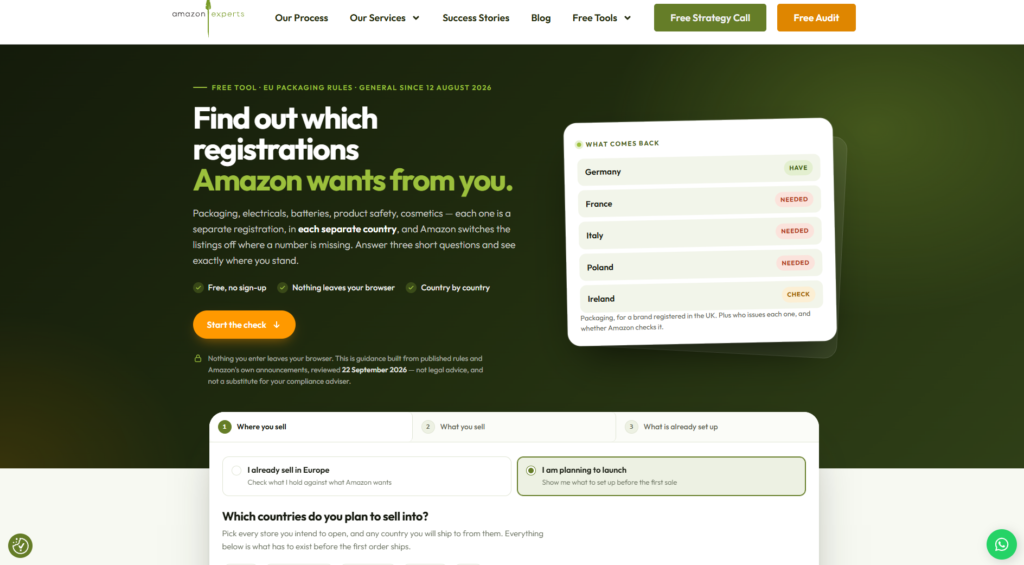
Going into another EU country?
Packaging, batteries, electricals, product safety, cosmetics — each is a separate registration in each separate country, and Amazon switches the listing off where a number is missing. Answer three questions and see which ones apply to you. Free, no sign-up.
Check my registrations →