Amazon product launch strategy often starts with one simple but tricky question: what should you launch first?
If you’re preparing to sell on Amazon, you’ve probably heard two popular approaches. One focuses on launching a Hero SKU. The other looks at riding demand by launching Best Sellers. Both sound reasonable. Both can work. But they lead to very different launch paths.
This is where many brands get stuck. Should you put all your effort into one flagship product? Or should you spread your risk across products that already sell well in the market? There’s no one-size-fits-all answer, and that’s exactly why this decision matters early on.
Amazon sellers and guides often describe the first 30-60 days as the critical period to build sales velocity and signal to the algorithm that a product deserves visibility. That’s why choosing what to launch first is not just a product decision, it’s a strategic one.
Understanding the Two Product Launch Approaches
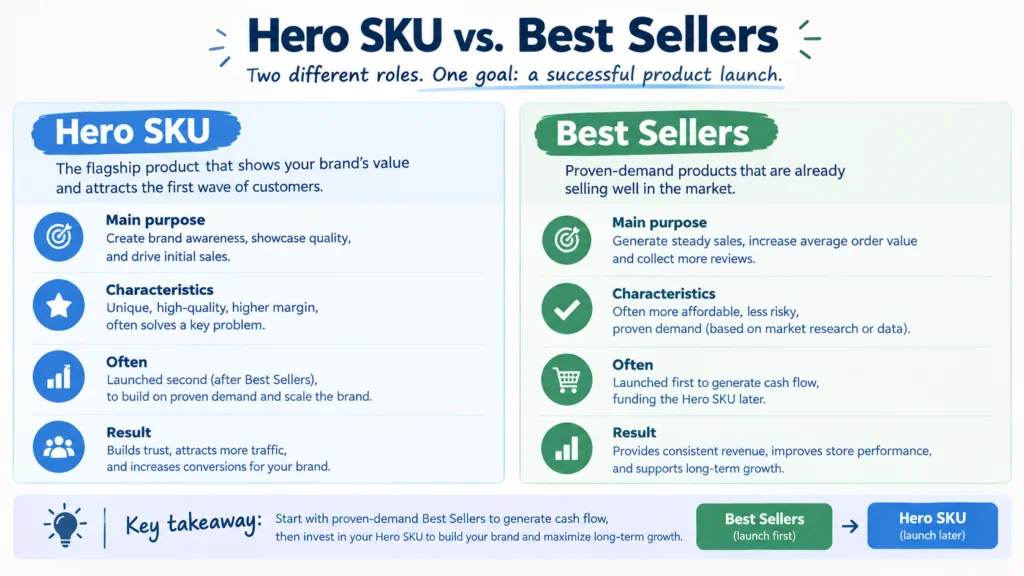
Before choosing what to launch first, it helps to clearly understand the two most common approaches on Amazon.
What Is a Hero SKU?
A Hero SKU is the one product you build your launch around. It is usually the item that best represents your brand. You invest most of your time, budget, and attention into making this product succeed.
This SKU often has a clear value proposition. It solves one main problem very well. Because of that, it is easier to tell a strong product story. Your listing, images, and ads all point to one goal: make this product stand out.
Launching a Hero SKU also helps with focus. Instead of managing many listings at once, you optimize one product deeply. You can test pricing faster. You can adjust messaging quickly. Over time, this Hero SKU can support future launches through brand trust and internal traffic.
However, this approach comes with risk. If the product fails, most of your launch effort fails with it. That’s why Hero SKU launches work best when product research is solid.
What Are Amazon’s Best Sellers?
Amazon’s Best Sellers approach looks at what is already selling well in a category. Instead of creating a flagship product, you launch products that match existing demand. This strategy reduces guesswork. Customers already buy these items. Search volume is proven. You are not educating the market from scratch.
Many sellers use this method to spread risk. If one product underperforms, another may still generate sales. It also allows faster scaling across multiple SKUs. The challenge here is competition. Best-selling products attract many sellers. Differentiation becomes harder. Pricing pressure is common.
So ask yourself this: do you want focus and brand-building, or diversification and faster validation? Your answer will shape your Amazon product launch path.
Launching a Hero SKU
Launching a Hero SKU is a focused way to enter the Amazon market.
Strategic Advantages of a Hero SKU
The biggest advantage of a Hero SKU is clarity. You know exactly which product you are pushing. Your messaging stays consistent. Your listing tells one clear story. This focus makes optimization easier. You can test images, titles, and pricing faster. You also learn quicker because all your data comes from one SKU. That feedback is valuable.
A Hero SKU also supports brand building. Customers start to recognize your product. Reviews concentrate on one listing. Over time, this creates trust. That trust helps when you launch new products later.
When your Hero SKU performs well, it can send visibility to your storefront and future SKUs. In simple terms, one strong product can lift the rest of your catalog. Of course, this path is not about quick wins. It’s about building a solid foundation.
Key Requirements to Launch a Hero SKU Successfully
First, product research must be strong. Your Hero SKU needs a real reason to exist. That could be a clear customer pain point or a meaningful improvement over competitors.
Second, you need budget control. Hero SKU launches often require upfront investment. This includes PPC, creatives, and early review strategies. You should be prepared for slow profit in the beginning.
Third, your listing quality must be high. Images should explain the value fast. Copy should stay simple and benefit-driven. Don’t try to say everything at once.
Finally, patience matters. A Hero SKU rarely takes off overnight. If you can test, learn, and optimize step by step, this strategy can pay off in a big way.
Launching Best Sellers
Launching Best Sellers is a popular path on Amazon, especially for sellers who want results sooner rather than later.
Why Sellers Choose Best Sellers
The biggest reason is simple: demand is already validated. Customers are buying these products every day. You don’t have to guess if people want them.
Data is also clearer. You can see search volume, BSR trends, and price ranges upfront. This makes planning easier. Revenue forecasting feels more realistic because benchmarks already exist.
For many sellers, this reduces uncertainty. You are not creating demand from zero. You are competing for a share of demand that is already there. Sounds attractive, right? That’s why this approach is so common.
Tactical Benefits
Best Sellers offer faster validation. You usually know within weeks if a product can sell. This helps you decide quickly whether to scale or stop. This strategy is also cash-flow oriented. With the right pricing and PPC control, products can generate revenue earlier than a Hero SKU.
Because of that, Best Sellers work well for:
- New sellers learning the Amazon system
- Sellers with limited capital
- Anyone who wants a lower risk around product–market fit
It’s a practical way to get experience and keep the business moving.
Structural Limitations
However, there are trade-offs. Competition is high. Price wars are common. Margins can shrink fast. Brand building is also harder. Many Best Sellers look similar. Customers remember the product, not the brand.
PPC costs tend to rise over time. More sellers bid on the same keywords. Defensibility is low, too. Successful products are easy to copy.
How to Choose the Right Amazon Product Launch Strategy
Choosing the right Amazon product launch strategy is less about trends and more about self-assessment. Many sellers ask, “Which strategy is better?” A better question is, “Which strategy fits my situation right now?”
Choose a Hero SKU If
You want to build a brand for the long term. A Hero SKU gives you a clear identity on Amazon. Customers remember one strong product more easily than many average ones.
You also need a marketing and branding budget. Hero SKU launches usually require stronger creatives, consistent PPC testing, and time to collect reviews. Results come slower, but they tend to last longer.
Another key factor is insight. If you understand customer pain points well, a Hero SKU makes sense. You can design the product and the listing around one clear problem. That focus is powerful.
Finally, you must be ready to accept early losses. Most Hero SKUs don’t turn profitable right away. If you can treat the first phase as an investment, this path can pay off later. This option works best for sellers who think in years, not weeks.
Choose Best Sellers If
Your main goal is faster cash flow. Best Sellers tap into demand that already exists. You are not waiting for the market to understand your product. This strategy also fits sellers with limited capital. You can start smaller, test faster, and avoid heavy upfront branding costs.
If you are new to Amazon, Best Sellers are a good training ground. You learn how PPC works. You understand listing optimization. You see how the system behaves with less pressure.
It’s also ideal for market testing. Before committing to a big brand idea, you can validate categories and pricing.
So pause for a moment. Be honest about your goals, budget, and experience. The right launch strategy is the one that matches where you are today, not where you hope to be tomorrow.
The Hybrid Approach: Using Best Sellers to Fund a Hero SKU
In many real cases, the smartest Amazon product launch strategy is not choosing sides. It’s combining both approaches in a deliberate way. This is known as the hybrid model, and it’s widely used by sellers who scale successfully.
The idea is simple. You launch Best Sellers first. These products follow existing demand and generate revenue earlier. At this stage, the goal is not brand building. The goal is cash flow and experience.
Once cash flow is stable, sellers reinvest it. This is where the Hero SKU comes in. Profits from Best Sellers fund R&D for a hero product. You can improve materials, add features, or solve a deeper customer pain point. Branding also becomes easier. You can afford better images, stronger copy, and custom packaging.
This shift is intentional. Best Sellers support the business. The Hero SKU defines the brand.
How to Validate Demand Before You Pick Your First Product
Both launch paths depend on the same thing: real demand. A Hero SKU needs a market big enough to justify the investment. Best Sellers need enough room for one more seller. Either way, you should check the numbers before you order inventory.
The good news is that Amazon doesn’t show you what people might buy. It shows you what they are already buying. Three signals do most of the work: Best Seller Rank (BSR), search volume, and competition.
Read BSR in Context
BSR shows how a product sells compared to other products in the same category. A lower number means more sales. Amazon updates it often, and recent sales carry more weight than older ones.
Here’s the catch. BSR is relative. It doesn’t tell you how many units a product sells per day, only how it ranks against its neighbors. A BSR of 10,000 in a large category can mean more sales than a BSR of 1,000 in a small one.
Still, rough ranges help you filter ideas:
- Below 5,000: very strong demand
- 5,000-20,000: solid demand, worth a closer look
- 20,000-50,000: moderate demand, needs confirmation
- Above 50,000: low demand, risky for a first launch
Never judge a market by one listing. A single BSR can jump after a promotion or a heavy ad push. Check the top 10 to 20 products, compare them only within the same category, and look for ranks that stay stable over time. If several listings sit in a healthy range, demand is likely real.
Confirm Buyer Interest with Search Volume
BSR tells you products are selling. Search volume tells you buyers are actively looking for them. When both line up, you can trust the signal.
Amazon doesn’t publish search volume, so you’ll need a tool like Helium 10, Jungle Scout, or DataHawk. Each one estimates differently, so don’t chase the exact number. Focus on the scale. A keyword with 300 searches a month behaves very differently from one with 30,000. Check the main buyer keyword, its close variations, and both singular and plural forms.
As a general guide:
- Under 1,000 searches/month: very low interest
- 1,000-5,000: niche demand, validate carefully
- 5,000-20,000: healthy demand for many products
- 20,000+: strong demand, usually very competitive
This is where your launch choice shows up again. The 20,000+ range is where Best Sellers usually live, along with big brands and aggressive bidding. A Hero SKU often has a better chance in a market with moderate volume and weaker competition.
Judge Competition by Page One
Competition is not about how many sellers exist. It’s about who controls the first page. So ask yourself: how hard would it be to beat what’s already ranking?
Look at three things. First, review counts in the top 10. If most listings have thousands of reviews, ranking will take time and budget. If several have a few hundred, entry is more realistic. Second, price and margin. Take the average selling price and work backward. Can you cover product cost, FBA fees, and ads and still make a profit? Third, listing quality. Weak images, unclear titles, or no A+ Content on page one usually mean room for a better offer. Amazon says Basic A+ Content can lift sales by up to 8%, so if competitors already use it well, you’ll need to match them.
Then watch for three red flags: review counts in the thousands, a race to the bottom on price, and big brands dominating the top results. One of them alone is not a deal-breaker. All three together usually mean an overcrowded market. For a Best Seller, that’s a reason to walk away. For a Hero SKU, it means you need a very clear advantage before you commit.
Your First 90 Days: A Simple Launch Timeline
Once you’ve picked what to launch, the first 90 days follow a similar rhythm for both strategies. The difference is patience. With a Best Seller, you usually decide by the end of month two whether to scale or stop. With a Hero SKU, you stay in the optimization stage longer.
Days 1-30: Get the Product and Listing Ready
Start with compliance. Categories like electronics, baby products, and cosmetics often need extra certifications. Check Product Compliance in Seller Central, ask your supplier which certificates they already have, and decide early if you need lab testing. It’s much easier than having a listing blocked after upload.
If you have a trademark, start Brand Registry now. It unlocks A+ Content and gives your listing more protection.
Then prepare the listing. Write three to five title versions, each with the main keyword and one key benefit. Build bullets around a simple flow: benefit, then feature, then result. Plan your image set before the shoot:
- 1 clean main image
- 3 lifestyle images
- 1 infographic
- 1 size guide
Finally, plan your inventory. Estimate expected daily sales for the first 30-60 days and add a 50% buffer. FBA usually suits small, light products. FBM can work better for bulky or low-margin items. Either way, reorder when stock drops to around 25-30%.
Days 31-60: Launch and Optimize
Publish the listing, make sure inventory is checked in, and start with automatic PPC campaigns. Let them run for a few days, then move the search terms that convert into manual campaigns. Keep bids simple. The goal here is data, not aggressive spending.
Use that data to test. Try a new main image. Try a shorter title. Adjust the bullets. Review the results every three to five days.
Don’t forget the customer side. Reply to messages daily and read early reviews closely. If buyers mention confusing packaging or missing parts, fix it fast. A simple insert card with usage steps can reduce returns. And restock before you drop below 20-5 days of cover. Stockouts hurt ranking, especially this early.
Days 61-90: Scale What Works
Now go back to the numbers. Raise bids on keywords that convert well. Add Sponsored Brands or Sponsored Display for brand visibility. Keep the structure clean. Scaling means doing more of what works, not testing everything at once.
This is also the moment to look at your catalog. Customer questions and early reviews often point to the next variation buyers want, such as a new size, color, or bundle. Launch only what you can support with stable inventory. For many sellers, this is where the hybrid approach really starts.
If You Already Sell on Shopify
DTC brands moving from Shopify have one big advantage: a warm audience. Send your email list and social followers to the Amazon listing in the first weeks. Amazon rewards sales velocity, not branding, so those early orders matter.
Expect colder traffic than on your own store. Conversion depends on how clear your listing is. You also no longer control the checkout, so fast customer support becomes part of your edge.
Over time, let the two channels support each other. Keep branding consistent, add Amazon links to your Shopify site for shoppers who prefer Prime, and send out-of-stock Shopify items to Amazon so you don’t lose the sale.
Bundles and Multipacks: Growing Beyond Your First SKU
Once your first product sells, bundles and multipacks are an easy way to raise order value without launching a new product line. Some sellers see Average Order Value increase by 15-30% with bundles. But the setup you choose affects reviews, SEO, and inventory, so it’s worth getting right.
Bundle or Multipack?
A bundle combines different products that are used together, like a shampoo and a conditioner. A multipack is the same product sold in multiple units, like a 3-pack of soap bars. Bundles focus on variety. Multipacks focus on quantity and a better per-unit price.
Multipacks almost always need their own ASIN. The quantity changes, so shoppers and Amazon both treat it as a different product. This often fits Best Sellers in consumable categories, where buyers actively look for multi-unit options.
New ASIN or Virtual Bundle?
A new ASIN gives the bundle its own page, title, images, and price. Amazon requires it for physical bundles packed and shipped as one unit. It also helps when you want a premium offer, like a gift set, with clean pricing. The downside is simple: it’s a new launch. Reviews and ranking start from zero, and you may need ads to get traction.
Virtual Bundles are faster. If you are Brand Registered, you can group two to five eligible ASINs in Seller Central without creating a new ASIN. Amazon ships each item separately, and the bundle shows reviews from the included products. Each item keeps its own stock, which is deducted when the bundle sells. If one item runs out, the whole bundle goes offline. You also can’t build an independent ranking history or fully control SEO.
So how does this fit your launch? A Virtual Bundle is a low-risk way to test whether your Hero SKU pairs well with a refill or accessory, using reviews it already has. If it sells, great. If not, you can remove it without long-term damage.
Conclusion
Choosing the right Amazon product launch strategy comes down to clarity, not perfection. Hero SKUs help you build a brand and long-term value. Best Sellers help you move faster and generate cash flow. Both approaches work when used with the right expectations.
The key is alignment. Your launch strategy should match your budget, experience, and goals at this stage. Some sellers start with focus. Others start with speed. Many successful brands combine both over time.
So don’t rush the decision. Understand where you are today. Then choose the path that helps you learn, grow, and stay in the game long enough to win on Amazon.
FAQs
1. Is a Hero SKU or Best Sellers better for beginners?
For most beginners, Best Sellers are easier to start with. Demand is already proven, and you can learn how Amazon works with lower risk. A Hero SKU is possible, but it usually requires more budget and patience.
2. Can I switch strategies after launching my first product?
Yes, and many sellers do. Your Amazon product launch strategy is not fixed. You can start with Best Sellers to build cash flow, then move toward a Hero SKU when you’re ready.
3. Does the hybrid approach really work long term?
It does when executed with focus. Best Sellers support the business financially, while the Hero SKU builds the brand. Together, they create a more balanced and sustainable growth path on Amazon.