Here’s the question every US brand and finance lead should answer before launching on Amazon Europe: EFN or Pan-EU? Get it wrong, and you can end up registered for VAT in five countries within your first year, most of which barely sell anything. Get it right, and you avoid multiple VAT registrations until sales in each country actually justify adding more. This guide breaks down which fulfillment model fits where you are today, and when it’s worth switching.
Why VAT Registration Count Is the Real Cost of Expanding to Amazon Europe
Most US sellers budget for Amazon fees, shipping, and advertising when they plan a European launch. Few budget for VAT registration itself. Each EU country you register in adds its own filing calendar, local accountant, and penalty regime if you’re late. Multiply that by five or six countries under Pan-EU FBA, and VAT compliance alone can run several thousand dollars a year before you’ve sold meaningful volume in some of those markets.
The fastest way to protect margin is to choose a fulfillment model that matches your actual sales volume per country, that’s what lets you avoid multiple VAT registrations instead of scaling into them by default.
EFN, MCI, Pan-EU, and OSS: Choosing the Fulfillment Model That Limits VAT Registrations
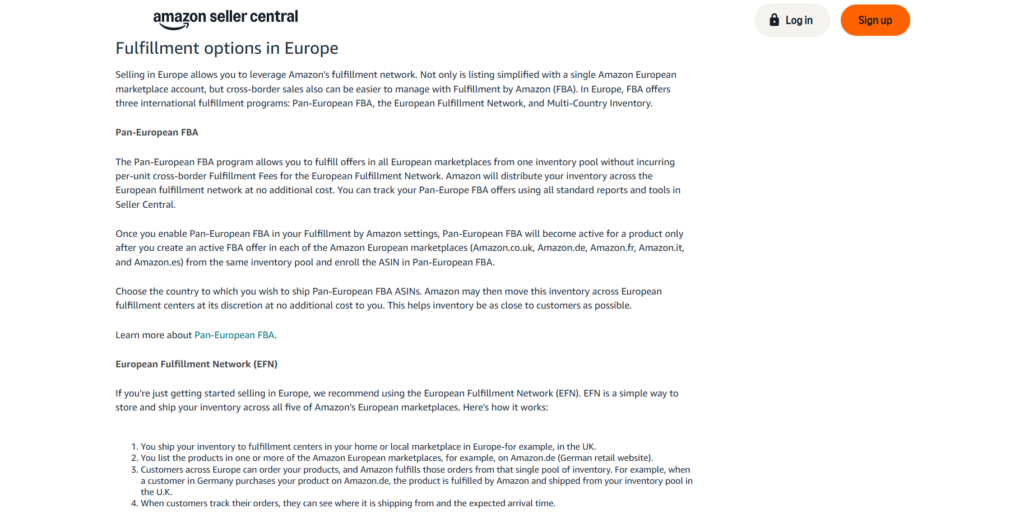
Amazon gives you three ways to store inventory in Europe, and each one comes with a different VAT price tag, here’s how they compare.
European Fulfillment Network (EFN): One VAT Number, Slower Delivery
EFN is generally the simplest way to reduce VAT registrations that Amazon otherwise pushes you toward. Your Amazon EFN VAT setup requires local registration only where your stock physically sits, commonly Germany, Poland, or the Czech Republic, while Amazon ships orders across the EU from that warehouse. Cross-border sales from that stock still carry VAT obligations, typically handled through the OSS scheme (more below).
The trade-off: cross-border EFN orders arrive slower and cost more per shipment, and you lose some Pan-EU-only Prime benefits.
Multi-Country Inventory and Pan-EU FBA: More Speed, More VAT Registrations
Multi-Country Inventory (MCI) lets you choose which countries hold stock, and Pan-EU FBA has Amazon distribute inventory automatically for the fastest delivery times.
Both boost sales velocity and Buy Box performance. Both also require an Amazon Pan-EU VAT registration in every country participating in the network, no exceptions, and the minimum participating-country count has changed before (most recently reported at five), so confirm it directly in Seller Central before enrolling.
If your goal is to minimize VAT registrations under Pan-EU, delay this model until sales in each target country justify the cost.
The VAT One Stop Shop (OSS) Scheme: What It Does and Doesn’t Cover
The VAT OSS scheme Amazon sellers rely on lets you file one quarterly return covering cross-border B2C sales, instead of registering separately in every country you sell into.
Per the European Commission, the EU-wide distance selling threshold governing this scheme is €10,000 in combined cross-border sales per year, but that only benefits EU-established businesses. A US-established brand doesn’t get that buffer: destination-country VAT applies from your first cross-border sale. OSS still helps, as long as goods ship from an EU-based warehouse, you report those amounts through one filing instead of registering locally everywhere you sell.
The catch: OSS simplifies reporting; it does not replace local VAT registration wherever inventory is physically stored. If Amazon holds stock abroad, automatic under MCI and Pan-EU, you still need local registration there. That distinction is how you avoid unnecessary VAT registrations once Pan-EU is active.
| Fulfillment Model | VAT Registrations Needed | Delivery Speed | Best For |
| EFN | Generally 1 (storage country) + OSS for cross-border | Slower cross-border | Testing new markets |
| MCI | 1 per country you choose to store stock in | Faster, selective | Scaling specific countries |
| Pan-EU FBA | 5+ (reported minimum, confirm in Seller Central) | Fastest, EU-wide | High-volume, multi-country sellers |
Choosing the right entry point comes down to sales forecasts by country, something our Amazon consulting team maps out before you commit.
Common Mistakes US Brands Make With Amazon Europe VAT Registration
US sellers repeat the same errors when they try to avoid multiple VAT registrations on Amazon Europe:
- Enrolling in Pan-EU before confirming demand, then paying for VAT registrations in markets with almost no sales.
- Assuming OSS replaces local registration, it doesn’t, once Amazon stores stock abroad.
- Missing the distinction between where you’re established and where inventory sits; both create separate VAT obligations.
- Waiting until Amazon suspends a listing for missing VAT numbers instead of registering proactively.
- Treating VAT as a one-time setup task instead of an ongoing obligation with country-specific deadlines, the same trap that catches manufacturers setting up UK VAT for the first time.
Each mistake is avoidable with a fulfillment plan built around your actual sales forecast, not the fastest possible EU-wide launch.
Estimated Cost Comparison: EFN vs MCI vs Pan-EU FBA
VAT registration count isn’t just an administrative detail, it’s a real line item. Based on typical third-party VAT compliance provider rates, here’s roughly what each fulfillment model costs to stay compliant each year.
| Fulfillment Model | VAT Registrations Needed | Estimated Annual VAT Compliance Cost |
| EFN | 1 (storage country) + OSS for cross-border | ~$2,000-$4,000/year |
| MCI | 1 per country you choose | ~$2,000-$5,000/year, per country |
| Pan-EU FBA | 5+ (current reported minimum) | ~$10,000-$25,000+/year for the full setup |
Costs vary by provider and country, and don’t include extra accountant or fiscal representative fees some countries require on top of standard filing. The current Amazon Pan-EU minimum VAT countries requirement covers Germany, France, Poland, Italy, and Spain, which is exactly why most US brands start with EFN in one of those markets and add registrations one country at a time, instead of paying for five VAT filings before proving demand in any of them.
VAT is one layer of several that have to line up before a European launch holds together. The full map sits in our Amazon EU compliance guide.
Deciding to expand is one thing; sequencing the markets, registrations and listings so they hold together is another. That is what we do on Amazon Europe expansion projects.
Two More VAT Mistakes Non-EU Sellers Make
Skipping fiscal representation where it is required
A fiscal representative is a licensed third party, usually a tax adviser or accounting firm, that takes on VAT responsibility for a non-EU seller in a given country. Several EU countries, Italy and France among them, require many non-EU businesses to appoint one, and the rules depend on the country and on whether your home country has a tax cooperation agreement with the EU. Skipping it can lead to fines, back-dated VAT with interest, and an Amazon suspension once the tax authority gets involved. Check each market before you register; our guide to the fiscal representative for Amazon Europe walks through how it works.
Misreading Amazon’s deemed reseller rules
Since the EU e-commerce VAT changes of July 2021, Amazon is treated as the deemed supplier for many B2C sales by non-EU sellers and collects and pays the VAT on those orders. Sellers often read this as “Amazon handles VAT for me” and stop there. That leads to two opposite errors: reporting every sale again and paying VAT twice, or reporting nothing, so B2B orders and other sales Amazon did not cover go unreported.
Split your sales clearly: the ones where Amazon accounted for VAT and the ones that are your responsibility. Amazon’s VAT Transaction Reports in Seller Central show which is which, and an accountant with real marketplace experience should check the split.
Conclusion
Start narrow. Most US brands overestimate how fast they need Pan-EU FBA and underestimate what five or six simultaneous VAT registrations cost in time and money. Launch with EFN in one strong market, confirm your OSS obligations from the first cross-border sale, and only add local VAT registrations where sales data proves it’s worth it. This sequence lets you avoid multiple VAT registrations in year one, while keeping the door open to scale into Pan-EU once specific countries earn it.
Ready to map out a VAT-smart entry into Amazon Europe? Book a free consultation with our team, and we’ll help you avoid multiple VAT registrations for your current sales volume.
1. Do I Need to Register for VAT in Every Country Where Amazon Stores My Stock?
Yes. Any time Amazon physically stores inventory in an EU country, you need a local VAT registration there, no minimum sales threshold applies. This is why sellers who want to simplify Amazon Europe VAT compliance start with EFN instead of Pan-EU.
2. Can the OSS Scheme Replace VAT Registration for Amazon FBA Sellers?
No. OSS simplifies reporting for cross-border sales, but doesn’t remove the requirement to register locally wherever inventory is stored. Most active FBA sellers use both: local registration for storage countries, plus OSS for the rest.
3. How Many VAT Registrations Does Amazon’s Pan-EU Program Require?
Amazon requires a registration in each country participating in the Pan-European FBA network, currently reported at a minimum of five, though this has changed before. Verify the exact requirement in Seller Central before you enroll.
4. What’s the Difference Between EFN and Pan-EU FBA for VAT Purposes?
If inventory stays in one EU country, EFN generally limits local VAT registration to that country. Pan-EU FBA spreads stock across multiple countries automatically, meaning a separate local registration in each one.
5. Can a US Brand Sell on Amazon Europe With Just One VAT Registration?
In many cases, yes, provided cross-border sales into other EU countries are handled through OSS. Unlike EU-established sellers, US brands don’t get the €10,000 buffer before destination-country VAT applies, but OSS still lets you report it in one filing rather than registering locally everywhere you sell.
Which registrations does Amazon want from you?
Answer three questions and get a country-by-country list for the EU and UK — packaging, batteries, electricals, product safety, cosmetics. Free, no sign-up.
Check my registrations →