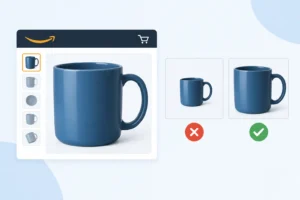
Amazon ACOS lets sellers measure the impact of their advertising efforts on Amazon.
In this quick guide, we’re going to cover what ACOS is and how it can benefit sellers.

Introduction to Amazon ACOS
Definition of ACOS (Advertising Cost of Sales)
Amazon ACOS, or Advertising Cost of Sales, according to Amazon, is “…A metric used to measure Amazon pay-per-click (PPC) advertising campaigns.”Importance of ACOS in Amazon PPC
ACOS helps sellers determine if their sponsored ads were cost-efficient and compare the money spent on PPC ads to the money earned.Calculating Amazon ACOS
Classic ACOS formula: Ad Spend / Ad Sales
The classic ACOS formula divides ad spend by sales then converts that number into a percentage. The formula is as follows: ACOS = (ad spend ÷ ad revenue) x 100Worked example: how to calculate ACOS
Say your campaigns spent £250 last month and the Amazon PPC ads report shows £1,000 in attributed sales. ACOS = (£250 ÷ £1,000) x 100 = 25% In other words, every £1 of ad sales cost you 25p in advertising. ROAS is the same number turned around: £1,000 ÷ £250 = 4, so ROAS = 100 ÷ ACOS. Whether 25% is good depends on your margin, which is what break-even ACOS tells you below.New ACOS Formula

Introduction to the updated formula developed in 2023
The new ACOS formula is a forecasting formula developed by Elizabeth Greene from Junglr.New formula: ACOS = (Avg CPC * (1/CVR)) / Average Order Value
This formula is designed to identify fluctuations in Amazon ACOS. The higher your ACOS, the more valuable this new formula is for finding out how to bring it down.Breakdown of components and significance
Let’s take a closer look of the formula and what each part signifies and how to use it. ACOS = (Avg CPC * (1/CVR)) / Average Order Value- Input the ACOS you want to achieve in the forecasting part of the formula.
- Type your average CPC times 1 divided by your CVR.
- Then divide by your Average Order Value.
Impact of Conversion Rate on ACOS
The conversion rate is the percentage of clicks that result in a sale. It is a key metric to measure the performance of an advertising campaign. The ACOS, or advertising cost of sales, is the ratio of ad spend to sales revenue. It indicates how much it costs to generate a sale from an ad. The conversion rate and the ACOS are inversely related. A higher conversion rate means that more clicks are converting into sales, which lowers the ACOS. A lower conversion rate means that fewer clicks are converting into sales, which increases the ACOS. Therefore, improving the conversion rate can help reduce the ACOS and increase the profitability of an ad campaign.Influence of Amazon PPC on Conversion Rate
Amazon PPC and the conversion rate share a symbiotic relationship in which both parties benefit indirectly. Amazon PPC gets your products in front of potential customers, but may not increase conversion rates if the product isn’t a good fit. On the other hand, a high-converting product will positively impact Amazon ACOS, and therefore, Amazon PPC performance.Using ACOS on Seller Central
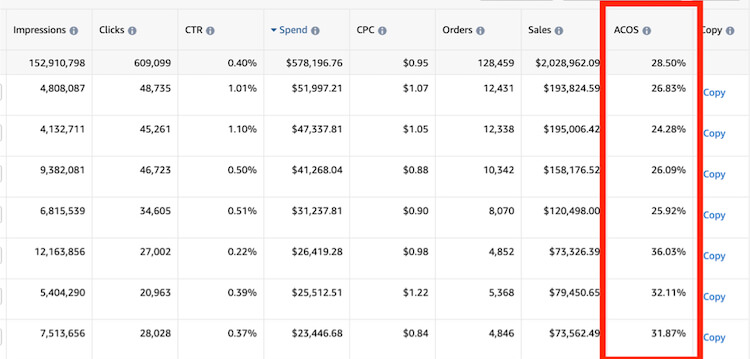
Accessing ACOS data on Seller Central dashboard
Find the ACOS column in Seller Central. It’s located after the Orders and Sales columns.Segmenting data at different levels: account, campaign, ad group
There are a few levels that Amazon automatically calculates ACOS data for:- Account: ACOS is calculated within a specific period for every campaign.
- Campaign: ACOS for ad groups and keywords are calculated for a campaign over a certain time period.
- Ad Group: A campaign ad group ACOS is calculated.
Importance of data segmentation for analysis
With these segments, sellers can breakdown data to see where they are performing the best and the poorest and capitalize on the positive feedback.Calculating Break-Even ACOS
To calculate your break-even ACOS, you need your profit per unit before advertising: the selling price minus cost of goods, Amazon referral fee and FBA fee. The formula for break-even ACOS is: Break-Even ACOS = (Profit before advertising ÷ Selling price) x 100 For example, if you sell a product for $20 and cost of goods plus Amazon fees come to $12, your profit before advertising is $8. Your break-even ACOS is ($8 ÷ $20) x 100 = 40%. If your ACOS is below 40%, the ads are profitable on those sales; above 40%, each ad-driven sale loses money.Importance of Total ACOS (TACOS) for budget control
TACOS, short for Total ACOS, measures advertising spend against all sales. It is calculated by dividing ad spend by total sales from both organic and paid traffic, then multiplying by 100. TACOS plays a role in evaluating the effectiveness and profitability of advertising campaigns while also providing insights into the well being of a business. A low TACOS indicates that the advertising spend is well-optimized and contributes to a higher profit margin. A high TACOS suggests that the advertising spend is too high or ineffective, and may erode the profit margin. Therefore, it is important to monitor and adjust TACOS according to the business goals and budget constraints.Understanding ACOS Benchmarks
Interpreting average, low, and high ACOS values
- Low ACOS: Generally between 15%-30%. Best for highest profitability.
- Average ACOS: Around 30%.
- High ACOS: 40% or higher. Best for greater visibility.
Case study: April as a profitable advertising month
According to Emplicit, the best days to advertise on Amazon are Wednesday and Sunday, “The best month to advertise is April, and the best times of the day to run ads are 8-10 a.m., 2-4 p.m., and 6-10 p.m.”Optimizing Product Pages and Ad Timing
Optimizing product pages and ad timing is a crucial strategy to improve the advertising cost of sales (ACOS) for e-commerce businesses. A well-optimized product page can increase the conversion rate of visitors who click on the ads, while a smart ad timing can reduce the wasted ad spend on irrelevant or low-intent audiences. By combining these two factors, e-commerce businesses can achieve a higher return on ad spend (ROAS) and lower ACOS.A high ACoS is a symptom, not a diagnosis. Finding the cause is the work we do in an Amazon consulting engagement.