
Many Turkish sellers start on Amazon EU with a simple mindset: list the products, make sales, figure out the rest later. Then a tax notice arrives, or the account gets suspended, and they realize they’ve been handling EU VAT wrong the entire time. The cost of that realization is rarely small. This article breaks down the 3 most common mistakes, why they happen, and how to avoid them before they quietly destroy your cash flow.
How EU VAT Works
EU VAT is not as complicated as it looks, but you need to understand the structure correctly from day one. There are two completely separate systems: the EU (27 countries) and the UK (post-Brexit). Confusing the two is where most problems start.
To put the stakes in perspective: the EU VAT compliance gap reached €128 billion in 2023, and as of January 2024, the EU’s DAC7 directive requires digital platforms like Amazon to automatically report seller data to tax authorities quarterly, meaning non-compliant sellers are now easily identified through automated data matching. The enforcement environment is fundamentally different from what it was even three years ago.
One OSS Registration Covers All 27 EU Countries
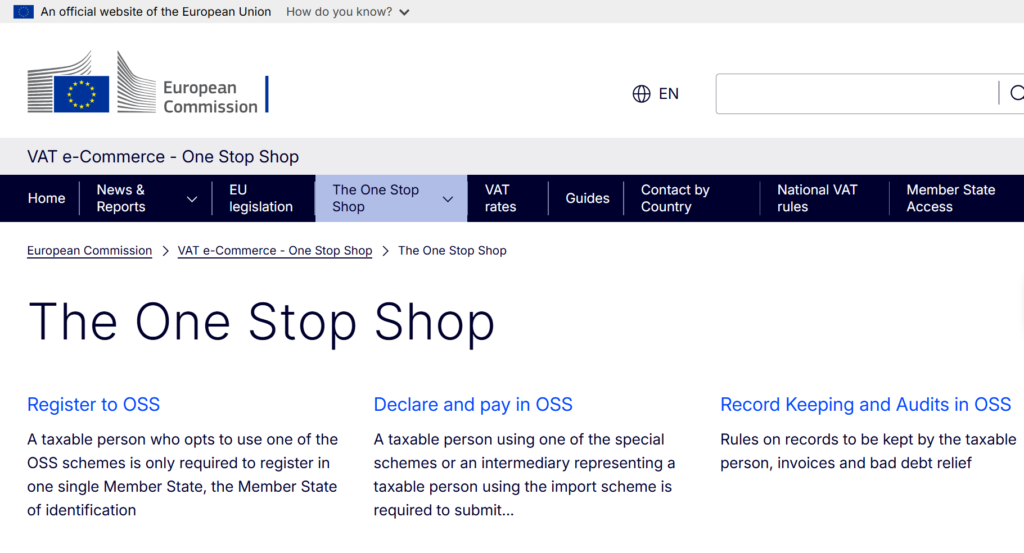
OSS (One Stop Shop) is the centralized VAT registration system that the EU launched in July 2021. Instead of registering separately in each country, you register once in a single EU member state, then report and remit VAT for all B2C transactions across the EU through one portal.
The most popular OSS registration countries for Turkish sellers are Germany and Czechia. Germany has a well-structured administrative system with many accountants experienced in handling non-EU sellers. Czechia offers lower compliance costs and a relatively fast registration process. Both are solid entry points if you don’t already have a legal presence in the EU. If you are still deciding which EU market to enter first, see Why Turkish brands should launch in Germany before the UK.
UK VAT Is Completely Separate After Brexit
Brexit fully separated the UK from the EU VAT system on January 1, 2021. If you sell on Amazon.co.uk, you need a separate UK VAT registration; OSS does not apply here.
The UK VAT threshold currently sits at £90,000 in annual revenue for sellers storing goods in the UK, but for non-UK sellers without UK-based inventory, the rules work differently. UK filing cycles run quarterly, which differs from the EU’s OSS scheme, where you can file quarterly or annually, depending on the option you choose. These are two independent systems; treat them that way.
Mistake #1: Registering VAT Separately in Every EU Country
This mistake usually starts during the research phase. Sellers hear “you sell in Germany, you pay German tax, you sell in France, you pay French tax”, and draw the wrong conclusion that they need a separate VAT registration in each country.
Why Turkish Sellers Fall Into This Trap
Before 2021, that was true. OSS changed everything. Many Turkish sellers still share outdated advice in communities, or consult local accountants unfamiliar with cross-border ecommerce, and end up with guidance that no longer applies.
The direct consequence: compliance costs multiply by 5 to 10 times. Registering VAT separately in Germany, Poland, France, Spain, and Italy can cost €3,000 to €8,000 per year in accounting fees alone. OSS eliminates that entirely with a single registration.
When You Still Need Local VAT Registration
OSS is not a universal solution. There are three situations where local VAT registration remains mandatory.
First, if your inventory is sitting in an Amazon fulfillment center inside the EU, for example, an FBA warehouse in Germany or Poland, you have tax nexus in that country and must register for local VAT regardless of revenue volume. Second, if you exceed the domestic threshold of a specific country through sales from a local warehouse, local registration is required. Third, if you sell B2B and your customers need invoices with a local VAT number, you need registration in that country.
IMPORTANT:
If your inventory is stored in an Amazon warehouse in DE or PL, OSS is not enough. You still need local VAT registration.
Mistake #2: Skipping Fiscal Representation in Germany, France, and Italy
The three largest EU markets all share one requirement that many Turkish sellers completely overlook, and the consequences usually only surface after a penalty has already landed. Fiscal representation is that requirement.
What Is Fiscal Representation and Who Needs It
A fiscal representative is a licensed third party, typically an accounting firm or tax advisor, that legally assumes VAT responsibility on behalf of a non-EU seller in a specific country.

Some EU countries, such as Italy and the Netherlands, require non-EU businesses to appoint a fiscal representative for VAT compliance, and these rules were tightened in 2025 with additional guarantees applying in some cases. Germany and France carry similar requirements for non-EU sellers with VAT obligations there.
This is not optional. It is a legal requirement, and tax authorities in all three markets enforce it seriously.
The Real Consequences of Ignoring This Requirement
If you skip fiscal representation in DE, FR, or IT, you face at least two risks. Amazon may suspend your account after tax authorities notify them of non-compliance. You can be fined and hit with retroactive VAT recovery, meaning you owe back taxes from the first day you started selling, plus interest and penalties.
The cost of hiring a fiscal rep typically runs €500 to €2,000 per year depending on the market. Compared to the risk of a retroactive bill that can span multiple years, that number is negligible.
Mistake #3: Misunderstanding Amazon’s Deemed Reseller Rules
This is the most subtle mistake, because it comes from an incomplete understanding of how Amazon handles VAT, not from knowing nothing at all.
What “Deemed Reseller” Actually Means for Non-EU Sellers
Under EU VAT rules effective July 2021, Amazon is treated as the “deemed reseller” in many B2C transactions involving non-EU sellers. This means Amazon collects and remits VAT on your behalf in those transactions.
Many sellers read this and conclude that Amazon handles everything, so they don’t need to do anything further on the VAT side. That conclusion is wrong, and it leads to serious compliance failures.
How Sellers Get It Wrong: Double-Reporting vs. Under-Reporting
There are two opposite errors. Some sellers report all revenue again, including transactions where Amazon already remitted VAT, and end up double-reporting and overpaying. Others report nothing at all, which means the transactions Amazon did not handle, such as B2B sales or certain fulfilled-by-merchant orders, go completely unreported.
Handling this correctly requires you to split each invoice clearly: which transactions Amazon processed VAT for, and which ones are your direct responsibility. That means understanding the VAT Transaction Reports in Seller Central and working with an accountant who has real Amazon marketplace experience.
How These 3 Mistakes Silently Drain Your Cashflow
None of these three mistakes produces immediate consequences, and that is exactly what makes them dangerous. Cash flow erodes gradually, and by the time you notice, the damage has already compounded.
A Real-World Example of VAT Gone Wrong
Consider a realistic scenario. A Turkish seller generates €50,000 per quarter on Amazon DE. They use FBA with inventory stored in Germany but skip local VAT registration, relying only on OSS. After 18 months, the German tax authority identifies the error.
The result: retroactive VAT recovery, late filing penalties, and interest charges covering the entire period of non-compliance. The double impact is what hurts most: money lost to penalties, plus revenue lost while the account is frozen during the investigation.
This is no longer a hypothetical risk. Since DAC7 took effect in January 2024, Amazon automatically reports seller sales data to EU tax authorities quarterly, and authorities can cross-reference that data against VAT filings. Penalties for non-compliance have increased 40 to 60% across most EU countries.
Why VAT Is a Business Strategy Problem, Not Just an Accounting Problem
Most sellers treat EU VAT as an accounting obligation: hire an accountant, file the reports, done. But VAT directly affects your pricing strategy. If you don’t factor the correct VAT rate into your selling price, your margin shrinks without you realizing it. That affects your ability to restock inventory, expand your catalog, and compete on price against other sellers in the same category.
Getting VAT compliance right doesn’t just protect you from penalties; it lets you price accurately, defend your margin, and make inventory decisions with confidence.
VAT is one layer of several that have to line up before a European launch holds together. The full map sits in our Amazon EU compliance guide.
Conclusion
EU VAT for Turkish sellers is not a simple topic, but it is manageable when you understand the structure correctly from the start. OSS handles the bulk of multi-country registration complexity. Fiscal representation protects you in the three largest markets. And understanding the reseller rules lets you report accurately, neither over nor under.
The enforcement landscape has hardened significantly since 2024. With the first DAC7 reports filed in 2024, EU authorities are now building their enforcement playbooks, and platforms that ignore compliance are likely to face consequences sooner rather than later. Getting this right now costs far less than fixing it after a tax authority has already been in touch.
1. Do Turkish Sellers Need to Register VAT in Every EU Country?
No. Since July 2021, OSS allows you to register once in a single EU country and report VAT for all B2C transactions across the bloc from that one registration. However, if you store inventory in an FBA warehouse inside the EU or exceed the domestic threshold of a specific country, local VAT registration in that country is still required.
2. Is UK VAT the Same as EU VAT After Brexit?
No. After Brexit, the UK separated fully from the EU VAT system. If you sell on Amazon.co.uk or store inventory in the UK, you need a separate UK VAT registration. OSS does not apply to the UK, and the filing thresholds and cycles are different from those in the EU.
3. Does Amazon Handle All VAT Automatically for Non-EU Sellers?
Not entirely. Amazon handles VAT in certain B2C transactions under deemed reseller rules but not all of them. B2B transactions, fulfilled-by-merchant orders, and certain edge cases remain your direct responsibility. You need to break down each transaction type in your VAT reports to report correctly and avoid both over- and under-reporting.
Which registrations does Amazon want from you?
Answer three questions and get a country-by-country list for the EU and UK — packaging, batteries, electricals, product safety, cosmetics. Free, no sign-up.
Check my registrations →