Launching new ASINs on Amazon is not about “listing and waiting.” The first 90 days are a controlled launch phase where Amazon’s algorithm decides whether your product deserves visibility.
Let’s break down what you should actually do in those first 90 days, how to structure your launch, drive the right signals, and give new ASINs the best chance to rank, convert, and scale sustainably
Week 1-2: Listing Foundation for New ASINs

The first two weeks decide whether your new ASIN gets traction or gets buried. If the foundation is weak, everything you do later becomes more expensive and less effective.
Keyword Research for New ASINs
For a new ASIN, keyword research is not about chasing the biggest search volume. It’s about relevance first, competition second.
Start by identifying core keywords, the exact phrases that clearly describe what your product is. These usually come from competitor listings that are already ranking on page one. Look at their titles, bullet points, and backend terms. If Amazon is rewarding them, that’s your clue.
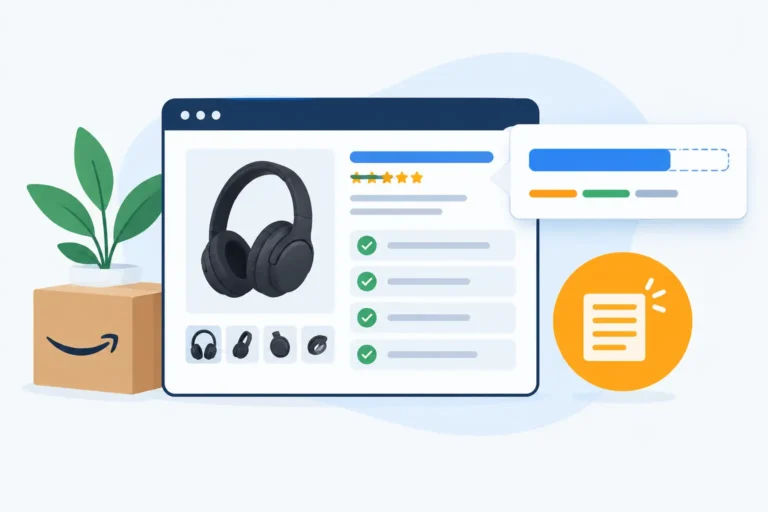
Optimizing Product Listing
Once keywords are locked, optimization is about clarity, not keyword stuffing.
Your title should focus on the main keyword and the core benefit, be clean, readable, and human.
Your bullet points should answer buyer questions fast: what it does, who it’s for, and why it’s better.
Your description or A+ content should reinforce trust, reduce hesitation, and visually explain value.
Backend search terms are where you support indexing, use secondary and long-tail keywords, and avoid repetition.
Remember this: a well-optimized listing doesn’t just rank better, it converts better. And for new ASINs, conversion rate is the fastest signal Amazon uses to decide whether you’re worth pushing.
Week 3-4: Soft Launch & Initial Data Collection
They are about learning. This phase matters more than many sellers realize. First 30-day performance now accounts for roughly 40-50% of a product’s 90-day ranking trajectory. At this stage, your new ASIN is live, indexed, and starting to get impressions. Now the question is simple: what actually works, and what doesn’t?
Think of this phase as a controlled experiment. You want clean data, not inflated numbers that hide real performance.
Pricing Strategy for New ASINs
Pricing in weeks 3-4 should remove friction, not maximize profit. Your goal is to encourage the first real buyers and generate early conversion data for Amazon’s algorithm.
Start slightly below the category average. Not cheap enough to hurt perceived quality, but attractive enough to win the click. Ask yourself: if you were the buyer, would this price feel “low risk” for an unknown product?
Avoid constant price changes. Give each price point enough time to collect data. Sudden swings confuse the algorithm and make your metrics unreliable.
If you use coupons, keep them simple. A small percentage off is often enough to improve CTR without training customers to wait for discounts.
Remember, pricing in this phase is temporary. You’re buying data, not locking in margins.
Low-Budget PPC Testing
PPC in weeks 3-4 is testing. If your ad spend feels uncomfortable, you’re probably spending too much.
Start with:
- Auto campaigns to discover search terms
- One manual campaign with exact and phrase match for your primary keywords
Keep daily budgets low. Focus on clicks, search term reports, and early conversion signals.
Do not chase ACoS yet. A new ASIN rarely looks “profitable” on paper in the first 30 days. What you want to see is:
- Which keywords convert
- Which keywords waste spend
- Which terms does Amazon naturally associate with your product
Every click in this phase is feedback. Use it.
Week 5-6: Sales Velocity & Visibility Boost
By weeks 5-6, your new ASIN is no longer “new” to Amazon. The system already has data on clicks, conversions, and buyer behavior. This is the moment where sales velocity starts to matter. More consistent sales mean more visibility. Less momentum means you slowly fade.
Scaling Amazon PPC for New ASINs
Start by looking at real performance data. Which keywords are converting? Those deserve higher bids and more budget. Raise bids gradually, not aggressively. Small increases keep performance stable while improving impressions.
Next, cut waste. Keywords with clicks but no conversions after enough spend should be paused. Every dollar spent on a bad keyword is a dollar taken away from a winner. Be disciplined here.
Now, separate intent clearly. Launch campaigns and scale campaigns serve different purposes. Launch campaigns exist to collect data and discover search terms. Scale campaigns exist to dominate keywords that already convert. Do not mix them. Keep launch campaigns low-budget and controlled. Put real budget behind scale campaigns built around exact-match, proven keywords.
External Traffic Strategy
Send traffic only to a listing that already converts. Otherwise, you amplify weak signals. Simple sources work best: social media posts, influencer shout-outs, or small creator collaborations. Avoid blasting cold traffic with no intent. We go through the channels, the tracking and the common mistakes in more detail in our guide to driving external traffic to Amazon storefronts.
Use Amazon-friendly links and track performance carefully. The goal is to reinforce sales velocity, improve brand signals, and help Amazon see demand beyond its own ecosystem.
Week 7-8: Conversion Optimization for New ASINs
At this point, your new ASIN already gets impressions and clicks. Now you need to tighten the funnel. Even small improvements in conversion rate can unlock more organic visibility.
Start with buyer behavior. Open your business reports and ask a simple question: where do shoppers hesitate?
Key areas to optimize:
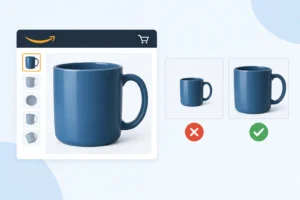
- Main image and gallery: Check your click-through rate first. If CTR feels low, the main image likely needs work. Test cleaner backgrounds, stronger lifestyle context, or clearer product scale. Inside the gallery, guide the buyer step by step: problem, solution, benefits, proof.
- Bullet points and above-the-fold content: Buyers scan fast. Reorder bullets so the strongest benefit comes first. Remove filler. Focus on outcomes, use cases, and objections you already see in reviews or PPC search terms.
- Pricing and incentives: Test small adjustments instead of big changes. A minor price drop, a coupon badge, or a limited-time deal often pushes hesitant buyers over the line without damaging perceived value.
- Early reviews and Q&A: Encourage legitimate reviews through Amazon-approved methods. Add clear answers in the Q&A section to remove last-minute doubts.
Week 9-10: Ranking Stabilization
Weeks 9-10 are where most new ASINs either settle into stable rankings or slowly slide backward. At this stage, Amazon already understands your product. The algorithm has enough data on clicks, conversions, and sales consistency. Your job now is simple: protect momentum and remove anything that creates volatility.
This phase is less about pushing harder and more about tightening control.
Focus on consistency across pricing, traffic, and sales velocity. Sudden changes send mixed signals and can reset the progress you’ve already made.
Key actions to prioritize:
- Stabilize pricing: Keep your price steady for at least 10–14 days. Let Amazon see predictable buyer behavior.
- Refine PPC bids: Hold strong-performing keywords at stable bids. Reduce aggressive bid changes. Small adjustments work better here.
- Defend page-one keywords: Exact-match campaigns for keywords already ranking should stay active with sufficient budget.
- Monitor organic vs paid balance: Organic sales should gradually replace some paid volume. Watch this ratio closely.
- Clean up low-quality traffic: Pause keywords bringing clicks without sales. Ranking stability depends on conversion quality.
This is also the moment to stop experimenting wildly. Listing images, bullets, and A+ content should already be proven. Minor tweaks are fine; full overhauls can hurt more than help.
Week 11-12: Scaling & Long-Term Growth
Weeks 11-12 are where you stop “launching” and start operating like a real brand. By now, Amazon already knows your ASIN. It has data on sales, conversion rate, and buyer behavior. Your job is no longer to push aggressively, but to scale what already works. Focus on consistency. Keep pricing stable. Maintain steady sales velocity. Avoid sudden changes that can reset momentum.
On the PPC side, shift budget toward exact-match keywords that consistently convert. These are your growth drivers. Raise bids slowly and watch impression share, not just ACoS. Scaling is about control, not speed. At this stage, organic sales should start replacing some paid volume. That’s a good sign. Let it happen. Don’t force it. A healthy mix of paid and organic sales is what keeps rankings strong long term.
Conclusion
The first 90 days are when Amazon decides how far your ASIN can go. This is your chance to earn trust from the algorithm through clear positioning, steady sales, and strong conversion. When the launch is controlled, growth becomes easier and more stable.
1. Why are the first 90 days so important for a new ASIN?
Because this is when Amazon learns who your product is for and whether buyers actually want it. Sales, clicks, and conversion rate in this period shape long-term visibility. If signals are weak, Amazon slows you down early.
2. Should I focus on profit during the first 90 days?
No. Early on, the goal is data and trust, not margin. You are proving demand, testing pricing, and finding converting keywords. Profit comes later, after rankings and organic sales are stable.
3. What separates a successful ASIN from a failed launch?
Control. Strong listings, steady pricing, clean PPC, and consistent sales velocity. Successful launches follow a plan instead of reacting emotionally. That discipline is what turns a new ASIN into a scalable asset.