Before listing a product on Amazon, the most important question isn’t “Does this product look good?” It’s “Are people actually buying it?” Many new sellers skip this step. The result is a live listing with little to no sales.
So, is there a way to check Amazon demand first? Yes. Amazon already gives you the data. The three key metrics are BSR, search volume, and competition. If you know how to read them correctly, you can evaluate market demand before spending money on inventory.
In this guide, I’ll walk you through how to use these metrics in a simple, practical way. No complex formulas. No confusing jargon. Just one goal: help you decide whether to move forward or walk away, before it’s too late.
What Is Amazon Demand?
When people talk about demand, they often think of the traditional market. That usually means broad consumer interest and long-term trends. On Amazon, demand works differently.
Amazon does not measure intent. It measures real buying behavior.
Instead of guessing whether people might buy, Amazon shows you whether they are already buying. And that data is available before you ever list a product.
| Traditional Market | Amazon |
| Based on general consumer demand | Based on real purchasing behavior |
| Focuses on long-term trends | Reflects demand in near real time |
| Uses surveys and market research | Uses live marketplace data |
| Measures interest and intent | Measures searches and sales |
| Demand is often qualitative | Demand is clearly data-driven |
In other words, Amazon’s demand is about action, not assumption.
That’s why validating Amazon demand is much more practical. You’re not predicting the future. You’re reading what is already happening.
And to do that, you only need to focus on three core metrics: Best Seller Rank (BSR), search volume, and competition.
Using Best Seller Rank (BSR) to Evaluate Demand
If you want a quick way to check Amazon demand, start with BSR. It’s one of the few metrics that reflects real sales activity, not assumptions. When BSR appears healthy, it usually indicates that products in that niche are selling consistently.
That said, BSR only works if you understand how to read it. Many sellers see a low number and get excited too fast. Let’s slow down and break it into parts.
What Is BSR and How Amazon Calculates It
BSR, or Best Seller Rank, shows how well a product is selling within its category. A lower BSR indicates better sales than other listings in the same category. Amazon updates BSR frequently. The calculation is based mainly on recent sales. Sales velocity also matters. Past performance plays a role, but short-term activity has more weight.
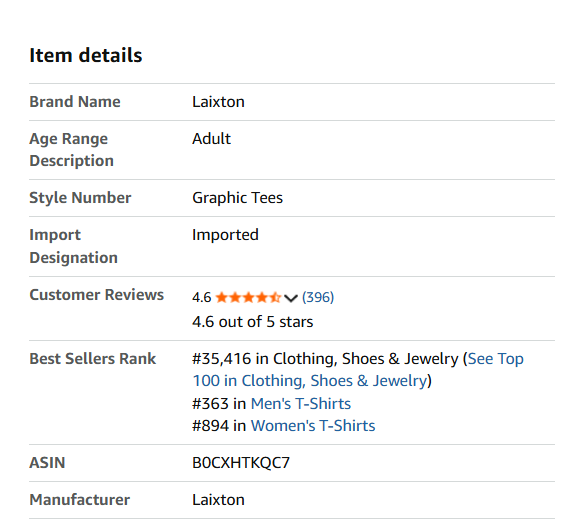
Source: Amazon
Here’s the key thing to remember: BSR is relative, not absolute. It does not tell you how many units a product sells per day. It only tells you how it ranks against competitors. That’s why context matters. A BSR of 10,000 in a large category can signal stronger demand than a BSR of 1,000 in a very small one. Always look at where the product sits, not just the number itself.
BSR Benchmarks by Category (What Is “Good” BSR?)
So, what counts as a “good” BSR? There’s no universal answer. Every category behaves differently. Some niches move fast. Others sell slower but more steadily.
Still, benchmarks can help you filter ideas:
- Below 5,000: Very strong demand, high sales velocity
- 5,000-20,000: Solid demand, worth deeper research
- 20,000-50,000: Moderate demand, needs confirmation
- Above 50,000: Low demand, risky for new sellers
Don’t rely on a single listing. Check the top 10 to 20 products. If several of them sit in a healthy BSR range, that’s a good sign. Consistency across listings usually means real demand.
Common BSR Mistakes to Avoid
One common mistake is judging a market based on one product’s BSR. That number can spike after a promotion or ads. Always review multiple listings to identify the pattern. Another issue is comparing BSR across different categories. This leads to false conclusions. BSR only makes sense within the same category.
Many sellers also ignore BSR fluctuations. A strong BSR for one day does not prove demand. Stable rankings over time are far more meaningful. Don’t assume a low BSR guarantees profit. High demand often attracts heavy competition. BSR tells you if a market is active, not if it’s easy.
Think of BSR as your first filter. It helps you spot demand. The next step is confirming that demand with search volume.
Using Search Volume to Confirm Buyer Interest
BSR tells you that products are selling. Search volume tells you why they are selling. It shows whether buyers are actively looking for a product or if sales come from a small group of listings.
Think of it this way: BSR shows results. Search volume shows intent. When both line up, demand is usually real.
That’s why search volume is a key step in validating Amazon demand. It helps you avoid markets that sell, but only because a few strong sellers dominate.
What Is Amazon Search Volume?
Amazon search volume measures how many times a keyword is searched on Amazon within a given period, usually per month. These searches come from buyers who already have purchase intent. This is very different from Google traffic. On Amazon, people search because they want to buy, not just learn. That makes search volume one of the strongest demand signals you can use.
For product research, you should focus on the main buyer keywords. These are direct phrases that describe the product. Not features. Not benefits. Just what people type when they want to buy, if no one searches for a product, sales will always be limited. Even a great listing cannot create demand from zero.
Tools to Check Amazon Search Volume
Amazon does not show search volume publicly. You need third-party tools to estimate it. Popular tools include Helium 10, Jungle Scout, and DataHawk. Each tool uses its own model, so numbers will vary. That’s normal.
The exact number matters less than the order of magnitude. A keyword with 300 searches behaves very differently from one with 30,000. When checking search volume, don’t rely on a single keyword. Look at:
- The main keyword
- Close variations
- Plural and singular forms
Together, these give you a clearer picture of buyer interest.
How Much Search Volume Is “Enough”?
This is one of the most common questions. The honest answer is: it depends on your goals and competition. As a general guide:
- Under 1,000 searches/month: Very low interest
- 1,000-5,000: Niche demand, needs careful validation
- 5,000-20,000: Healthy demand for many products
- 20,000+: Strong demand, often very competitive
High search volume is not always better. It often attracts big brands and aggressive sellers. Moderate volume with weaker competition can be a better entry point.
Search volume confirms interest. But interest alone is not enough. Next, you need to see how crowded the market really is.
| IMPORTANT A simple check helps. Search your main keyword on Amazon. Look at the top listings. Do they match what buyers are searching for? If yes, demand is clear. |
Analyzing Competition the Right Way

High demand is exciting. But competition decides whether you can actually win. Many new sellers avoid competitive markets too quickly. Others jump in without checking the details. Both are risky.
Competition on Amazon is not just about how many sellers exist. It’s about how strong the top listings are. Once you understand that, competition becomes easier to judge.
What High Competition Really Looks Like
A market is not “high competition” just because it has many listings. What matters is who controls the first page.
High competition usually means:
- Strong brands dominate the top results
- Listings have high review counts and high ratings
- Prices are pushed down with little room for margin
If the top 10 listings all look polished and similar, that’s a sign of a mature market. It doesn’t mean you can’t enter. It means you need a clear advantage.
On the other hand, if top listings look inconsistent, that’s an opportunity. Weak images, poor titles, or unclear positioning often signal room for improvement.
So instead of asking “Is this market crowded?”, ask: How hard would it be to beat what’s already ranking?
Key Competition Metrics to Check
To analyze competition properly, focus on a few clear signals. You don’t need complex spreadsheets.
Top 10 review counts: Look at how many reviews the top 10 listings have. If most of them have thousands of reviews, ranking will take time and budget. If several listings are under a few hundred, the entry becomes more realistic.
Price and profit margin: Check the average selling price. Then work backward. Can you cover product cost, FBA fees, ads, and still make a profit? If prices are in a race to the bottom, strong demand won’t save you.
Listing quality: This is often overlooked. Study images, titles, bullets, and descriptions. Do they clearly explain the product? Do they look professional? And, pay special attention to A+ Content. Many top sellers invest heavily here. Basic A+ Content can encourage repeat purchases and increase sales by up to 8%. If competitors are already using strong A+ layouts, you’ll need to match or exceed that level.
Red Flags That Signal an Overcrowded Market
Red Flags That Signal an Overcrowded Market. Not every competitive market is bad. But some markets send very clear warning signs. When you see several of these together, it’s time to slow down and think carefully.
The first red flag is extremely high review counts. If most top listings have thousands, or even tens of thousands of reviews, ranking will be difficult. It usually means sellers have been there for years. Breaking in will require heavy ad spend and a long timeline.
The second red flag is a race to the bottom on price. If many sellers offer similar products and keep undercutting one another, margins erode quickly. Even with strong demand, low pricing leaves little room for ads, returns, or mistakes. That’s a tough place for new sellers.
Another major warning sign is the dominance of large brands in the top results. When well-known brands dominate page one, they benefit from trust, budget, and brand searches. Competing head-to-head without a clear differentiation becomes very expensive.
One red flag alone is not always a deal-breaker. But when high reviews, low prices, and big brands all appear together, the market is likely overcrowded.
Conclusion
Validating Amazon demand is not about finding a perfect product. It’s about making a smart decision before you invest. Amazon already shows you what buyers are doing. You just need to read the signals correctly.
BSR tells you if products are selling. Search volume shows if buyers are actively looking. Competition reveals whether you can realistically enter and win. None of these metrics works alone. Together, they give you clarity.
Before you list anything, pause and check the data. Sometimes the best move is not to launch, but to walk away. That decision can save you time, money, and frustration.
FAQs
If a product has a good BSR, does that mean Amazon demand is guaranteed?
Not always. A good BSR shows that products are selling, but it doesn’t explain why they sell. Some listings perform well because of strong ads or brand power. That’s why you still need to check search volume and competition before making a decision.
Can I rely on search volume alone to validate Amazon demand?
No. High search volume shows interest, not sales. A keyword can be searched a lot, but if BSR across top listings is weak, it often means buyers are browsing, not buying. Amazon demand is strongest when search volume and BSR both support each other.
When should I walk away from a product idea?
You should consider walking away when BSR is weak, search volume is low, and competition is dominated by large brands with thousands of reviews. Launching in that situation usually requires more budget and time than it’s worth, especially for new sellers.