Are you running Amazon ads but feeling like the numbers never quite add up? You’re definitely not alone. Many sellers pour money into Amazon Sponsored Products, see sales coming in, yet ACOS stays stubbornly high. The issue usually isn’t the ad format; it’s how the campaigns are structured and optimized day to day. This blog post will explain everything about ACoS and how to Lower ACOS with Amazon Sponsored Products
Understanding ACOS in Amazon Sponsored Products
To use ACOS properly, you first need to understand how it’s calculated and how it connects to profit and growth.
What Is ACOS?
ACOS (Advertising Cost of Sales) tells you how much you’re spending on ads to generate revenue. The formula is simple: ACOS = Ad Spend ÷ Ad Sales × 100. If you spend $20 to make $100 in sales, your ACOS is 20%. On its own, that number doesn’t say much. ACOS becomes useful only when you put it next to your margins and goals.
The real relationship is between ACOS, profit margin, and scalability. If your product has a 30% margin and your ACOS sits at 35%, every ad-driven sale loses money. That’s not sustainable.
On the flip side, if your margin is strong and ACOS stays below it, ads can scale without killing cash flow. Many sellers fixate on lowering ACOS without checking whether it actually aligns with their margins. That’s how they end up cutting profitable traffic by mistake.
Target ACOS vs Break-even ACOS
Break-even ACOS is the maximum ACOS you can afford before ads stop being profitable. Target ACOS is the number you want to operate at based on growth plans, inventory, and cash flow. These two are not the same, and they shouldn’t be.
Chasing the lowest possible ACOS often slows growth. There are times when a higher ACOS makes sense, especially during product launches or when you’re trying to rank for competitive keywords. In those phases, ads work as visibility and momentum, not immediate profit. The key is knowing when high ACOS is intentional, and when it’s just wasted spend hiding in your campaigns.
While many sellers reference the 25-35% ACOS range as a general benchmark for Sponsored Products, the right target ACOS ultimately depends on margin structure, growth stage, and cash flow priorities.
Reasons Your Sponsored Products ACOS Is High
In most accounts, high ACOS is the result of small issues stacking up over time, wasted traffic, weak listings, and too much trust in automation.
Keyword Waste & Search Term Leakage
Broad and auto campaigns are the biggest sources of silent budget loss. They pull in volume fast, but a large share of that traffic never converts. Amazon’s algorithm is designed to maximize reach first, not efficiency. That means your ads can show for loosely related searches that generate clicks but no sales.
If you’re not reviewing search term reports regularly, this leakage keeps growing. Sellers often assume “more data” will fix the problem later, but in reality, wasted spend compounds long before profitable terms stand out.
Poor Listing Conversion Rate
High ACOS isn’t always a bidding problem. You can pay a reasonable CPC and still lose money if the listing doesn’t convert. Sponsored Products depend on two things: CTR and CVR. CTR gets shoppers to the page; CVR turns them into buyers.
Many sellers focus only on click-through rate and ignore what happens after the click. Weak images, unclear value propositions, or pricing gaps versus competitors will push CVR down, and ACOS up, no matter how well the campaign is structured.
Over-Reliance on Automation
Dynamic bids “up and down” sound efficient, but they don’t always work in the seller’s favor. Amazon optimizes for its own revenue, not your profit margin. Automation tends to increase bids where conversion might happen, even if the math no longer makes sense for your margins.
Step-by-Step Framework to Lower ACOS
Lowering ACOS works best when you follow a clear sequence.
Fix the Foundation: Listing Optimization Before Ads
Ads amplify whatever your listing already is. If the listing is weak, ads will only make that weakness more expensive. Your listing directly controls conversion rate, and conversion rate directly controls ACOS.

Focus first on:
- Title: Clear keyword relevance without stuffing. A clear title improves relevance.
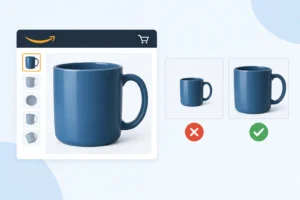
- Main image: Clean, high-contrast, easy to understand on mobile. Strong main image stops the scroll
- A+ content: Visual proof, objections handled fast, no filler. A+ content reduces buyer hesitation once they land on the page.
When these elements work together, every click has a higher chance of turning into a sale.
Never scale ads on a weak listing. If conversion is poor, lowering bids won’t fix the problem. You’ll just get fewer clicks and the same ACOS. Fix the listing first, then push traffic.
Restructuring Campaigns for ACOS Control
Campaign structure determines how much control you actually have. Auto campaigns should be used for mining, not long-term scaling. Let them collect data, then pull converting search terms into manual campaigns.
Manual campaigns should be separated by match type: Exact, Phrase, and Broad.
- Exact: Proven, high-intent terms
- Phrase: Controlled expansion
- Broad: Discovery with tight negatives
This keeps performance data clean and makes bid adjustments more precise. Mixing match types hides what’s really driving ACOS. Stick to one ASIN per intent. Different products or variations often convert differently, and bundling them together blurs the numbers you need to act on.
Keyword-Level ACOS Optimization
Not every keyword deserves to stay alive. Decisions should be simple and consistent.
- Lower bids on terms with high spend and weak returns.
- Pause keywords that consistently burn budget without showing signs of conversion.
- Protect keywords that convert well, even if their ACOS looks slightly higher than average.
Use the search term report with intent. Don’t just look for “bad” terms to cut. Look for patterns: which phrases convert, which modifiers signal buying intent, and which searches attract browsers. ACOS-based bidding is useful, but profit-based bidding is better. Always check whether a keyword is actually making money after fees and margins, not just whether it hits an arbitrary ACOS target.
Negative Keywords: The Fastest Way to Cut ACOS
Negatives are the fastest way to stop waste. Add negative exact for search terms that are clearly irrelevant or consistently unprofitable. Use negative phrases to block entire clusters of low-intent searches. This keeps future traffic cleaner and protectsthe budget for terms that matter.
Audit negatives at least weekly on aggressive accounts and bi-weekly on stable ones. Waiting too long lets the waste pile up quietly. Consistent negative keyword management alone can bring ACOS down faster than any bid adjustment.
Advanced Bidding & Budget Strategies for Sponsored Products
When ACOS stays high even after cleanup, the problem is usually how bids and budgets are being deployed.
Smart Use of Dynamic Bidding
Dynamic bidding should support your strategy, not replace it. “Down only” works best when your keywords already convert, and you want to control CPC. It prevents Amazon from overpaying on uncertain traffic. “Up and down” can help win auctions, but it often raises bids on keywords that are only potentially profitable. Amazon increases bids based on conversion probability, not your margin. Use dynamic bidding sparingly and only on keywords you already trust.
Budget Reallocation, Not Budget Cutting
Lowering ACOS is rarely about spending less. It’s about moving the budget to where it actually works.
Prioritize spend on:
- Low ACOS keywords that stay profitable at scale
- High CVR keywords that consistently turn clicks into orders
At the same time, stop budget dilution. When budgets are spread across too many campaigns, strong keywords get capped while weak ones keep spending. Pause, cap, or isolate underperforming campaigns so profitable campaigns can fully spend. ACOS improves when good traffic isn’t starved.
Dayparting & Performance Timing
Conversion doesn’t happen evenly throughout the day. Certain hours consistently outperform others. Dayparting lets you push bids during high-conversion windows and pull back during low-quality traffic.
Smaller sellers benefit more because budget efficiency matters. Larger brands can absorb waste, but even they see cleaner ACOS when spend aligns with performance timing. Used correctly, dayparting sharpens results without increasing spend.
If ACoS has stayed stubbornly high across several restructures, the problem is usually upstream of the campaigns. An Amazon consulting audit finds where.
Conclusion
Lowering ACOS is about aligning ads with margins, listings, and real buying intent. When structure is clean, waste is controlled, and budget flows to what actually converts, Sponsored Products stop being a cost center and start supporting growth.
1. What is a good ACOS for Amazon Sponsored Products?
A good ACOS depends on your profit margin and business goals. If ACOS stays below your break-even point, your ads are doing their job. There’s no single “perfect” number that fits every seller.
2. Why does ACOS stay high even when bids are low?
Low bids don’t fix poor conversion. If your listing doesn’t convert or your ads attract the wrong search terms, ACOS stays high no matter how cheap the clicks are.
3. What is the fastest way to lower ACOS?
Start with negative keywords and search term cleanup. Cutting wasted traffic usually reduces ACOS faster than changing bids or budgets.