Amazon product launch strategy often starts with one simple but tricky question: what should you launch first?
If you’re preparing to sell on Amazon, you’ve probably heard two popular approaches. One focuses on launching a Hero SKU. The other looks at riding demand by launching Best Sellers. Both sound reasonable. Both can work. But they lead to very different launch paths.
This is where many brands get stuck. Should you put all your effort into one flagship product? Or should you spread your risk across products that already sell well in the market? There’s no one-size-fits-all answer, and that’s exactly why this decision matters early on.
Amazon sellers and guides often describe the first 30-60 days as the critical period to build sales velocity and signal to the algorithm that a product deserves visibility. That’s why choosing what to launch first is not just a product decision, it’s a strategic one.
Understanding the Two Product Launch Approaches
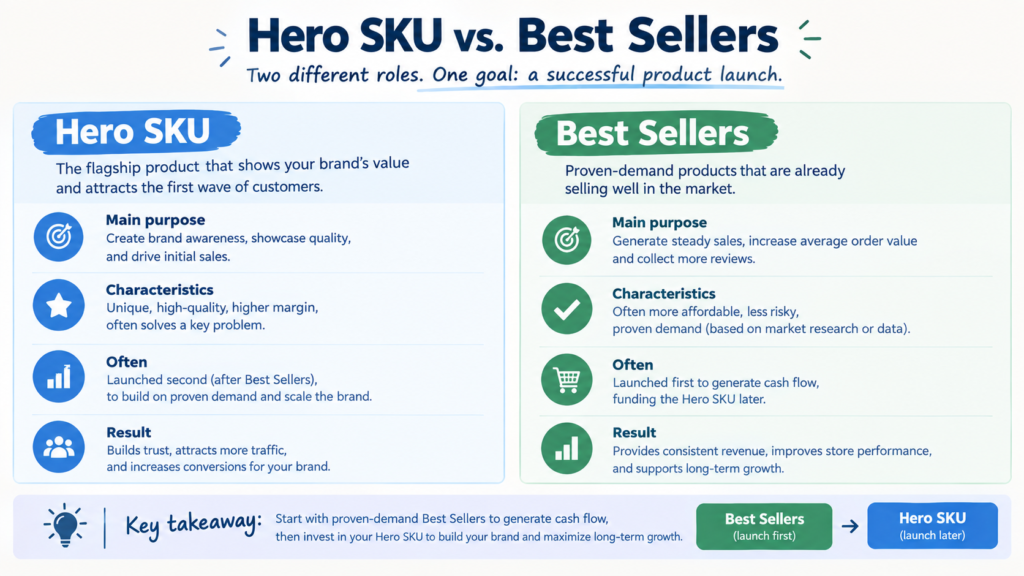
Before choosing what to launch first, it helps to clearly understand the two most common approaches on Amazon.
What Is a Hero SKU?
A Hero SKU is the one product you build your launch around. It is usually the item that best represents your brand. You invest most of your time, budget, and attention into making this product succeed.
This SKU often has a clear value proposition. It solves one main problem very well. Because of that, it is easier to tell a strong product story. Your listing, images, and ads all point to one goal: make this product stand out.
Launching a Hero SKU also helps with focus. Instead of managing many listings at once, you optimize one product deeply. You can test pricing faster. You can adjust messaging quickly. Over time, this Hero SKU can support future launches through brand trust and internal traffic.
However, this approach comes with risk. If the product fails, most of your launch effort fails with it. That’s why Hero SKU launches work best when product research is solid.
What Are Amazon’s Best Sellers?
Amazon’s Best Sellers approach looks at what is already selling well in a category. Instead of creating a flagship product, you launch products that match existing demand. This strategy reduces guesswork. Customers already buy these items. Search volume is proven. You are not educating the market from scratch.
Many sellers use this method to spread risk. If one product underperforms, another may still generate sales. It also allows faster scaling across multiple SKUs. The challenge here is competition. Best-selling products attract many sellers. Differentiation becomes harder. Pricing pressure is common.
So ask yourself this: do you want focus and brand-building, or diversification and faster validation? Your answer will shape your Amazon product launch path.
Launching a Hero SKU
Launching a Hero SKU is a focused way to enter the Amazon market.
Strategic Advantages of a Hero SKU
The biggest advantage of a Hero SKU is clarity. You know exactly which product you are pushing. Your messaging stays consistent. Your listing tells one clear story. This focus makes optimization easier. You can test images, titles, and pricing faster. You also learn quicker because all your data comes from one SKU. That feedback is valuable.
A Hero SKU also supports brand building. Customers start to recognize your product. Reviews concentrate on one listing. Over time, this creates trust. That trust helps when you launch new products later.
When your Hero SKU performs well, it can send visibility to your storefront and future SKUs. In simple terms, one strong product can lift the rest of your catalog. Of course, this path is not about quick wins. It’s about building a solid foundation.
Key Requirements to Launch a Hero SKU Successfully
First, product research must be strong. Your Hero SKU needs a real reason to exist. That could be a clear customer pain point or a meaningful improvement over competitors.
Second, you need budget control. Hero SKU launches often require upfront investment. This includes PPC, creatives, and early review strategies. You should be prepared for slow profit in the beginning.
Third, your listing quality must be high. Images should explain the value fast. Copy should stay simple and benefit-driven. Don’t try to say everything at once.
Finally, patience matters. A Hero SKU rarely takes off overnight. If you can test, learn, and optimize step by step, this strategy can pay off in a big way.
Launching Best Sellers
Launching Best Sellers is a popular path on Amazon, especially for sellers who want results sooner rather than later.
Why Sellers Choose Best Sellers
The biggest reason is simple: demand is already validated. Customers are buying these products every day. You don’t have to guess if people want them.
Data is also clearer. You can see search volume, BSR trends, and price ranges upfront. This makes planning easier. Revenue forecasting feels more realistic because benchmarks already exist.
For many sellers, this reduces uncertainty. You are not creating demand from zero. You are competing for a share of demand that is already there. Sounds attractive, right? That’s why this approach is so common.
Tactical Benefits
Best Sellers offer faster validation. You usually know within weeks if a product can sell. This helps you decide quickly whether to scale or stop. This strategy is also cash-flow oriented. With the right pricing and PPC control, products can generate revenue earlier than a Hero SKU.
Because of that, Best Sellers work well for:
- New sellers learning the Amazon system
- Sellers with limited capital
- Anyone who wants a lower risk around product–market fit
It’s a practical way to get experience and keep the business moving.
Structural Limitations
However, there are trade-offs. Competition is high. Price wars are common. Margins can shrink fast. Brand building is also harder. Many Best Sellers look similar. Customers remember the product, not the brand.
PPC costs tend to rise over time. More sellers bid on the same keywords. Defensibility is low, too. Successful products are easy to copy.
How to Choose the Right Amazon Product Launch Strategy
Choosing the right Amazon product launch strategy is less about trends and more about self-assessment. Many sellers ask, “Which strategy is better?” A better question is, “Which strategy fits my situation right now?”
Choose a Hero SKU If
You want to build a brand for the long term. A Hero SKU gives you a clear identity on Amazon. Customers remember one strong product more easily than many average ones.
You also need a marketing and branding budget. Hero SKU launches usually require stronger creatives, consistent PPC testing, and time to collect reviews. Results come slower, but they tend to last longer.
Another key factor is insight. If you understand customer pain points well, a Hero SKU makes sense. You can design the product and the listing around one clear problem. That focus is powerful.
Finally, you must be ready to accept early losses. Most Hero SKUs don’t turn profitable right away. If you can treat the first phase as an investment, this path can pay off later. This option works best for sellers who think in years, not weeks.
Choose Best Sellers If
Your main goal is faster cash flow. Best Sellers tap into demand that already exists. You are not waiting for the market to understand your product. This strategy also fits sellers with limited capital. You can start smaller, test faster, and avoid heavy upfront branding costs.
If you are new to Amazon, Best Sellers are a good training ground. You learn how PPC works. You understand listing optimization. You see how the system behaves with less pressure.
It’s also ideal for market testing. Before committing to a big brand idea, you can validate categories and pricing.
So pause for a moment. Be honest about your goals, budget, and experience. The right launch strategy is the one that matches where you are today, not where you hope to be tomorrow.
The Hybrid Approach: Using Best Sellers to Fund a Hero SKU
In many real cases, the smartest Amazon product launch strategy is not choosing sides. It’s combining both approaches in a deliberate way. This is known as the hybrid model, and it’s widely used by sellers who scale successfully.
The idea is simple. You launch Best Sellers first. These products follow existing demand and generate revenue earlier. At this stage, the goal is not brand building. The goal is cash flow and experience.
Once cash flow is stable, sellers reinvest it. This is where the Hero SKU comes in. Profits from Best Sellers fund R&D for a hero product. You can improve materials, add features, or solve a deeper customer pain point. Branding also becomes easier. You can afford better images, stronger copy, and custom packaging.
This shift is intentional. Best Sellers support the business. The Hero SKU defines the brand.
Conclusion
Choosing the right Amazon product launch strategy comes down to clarity, not perfection. Hero SKUs help you build a brand and long-term value. Best Sellers help you move faster and generate cash flow. Both approaches work when used with the right expectations.
The key is alignment. Your launch strategy should match your budget, experience, and goals at this stage. Some sellers start with focus. Others start with speed. Many successful brands combine both over time.
So don’t rush the decision. Understand where you are today. Then choose the path that helps you learn, grow, and stay in the game long enough to win on Amazon.
FAQs
1. Is a Hero SKU or Best Sellers better for beginners?
For most beginners, Best Sellers are easier to start with. Demand is already proven, and you can learn how Amazon works with lower risk. A Hero SKU is possible, but it usually requires more budget and patience.
2. Can I switch strategies after launching my first product?
Yes, and many sellers do. Your Amazon product launch strategy is not fixed. You can start with Best Sellers to build cash flow, then move toward a Hero SKU when you’re ready.
3. Does the hybrid approach really work long term?
It does when executed with focus. Best Sellers support the business financially, while the Hero SKU builds the brand. Together, they create a more balanced and sustainable growth path on Amazon.