When it comes to expanding into Europe, many brands feel tempted to launch in every major market at once. The opportunities look massive, and scaling fast feels exciting. But for established accounts, the smarter approach isn’t spreading resources thin. It’s following a clear sequenced expansion playbook: UK → DE → FR.
Each of these markets behaves differently. The UK is fast-moving and conversion-driven, Germany is strict, compliance-heavy, and very detail-oriented, while France prioritizes brand experience and has its own SEO logic entirely. A sequenced strategy lets you leverage the data you already have from the UK, reduce compliance risks when entering DE, and optimize ROI before you tackle FR with deeper, more nuanced localization.
Why Sequenced Expansion Matters
Following a clear path like UK → DE → FR helps you build momentum without losing focus or stretching your team thin.
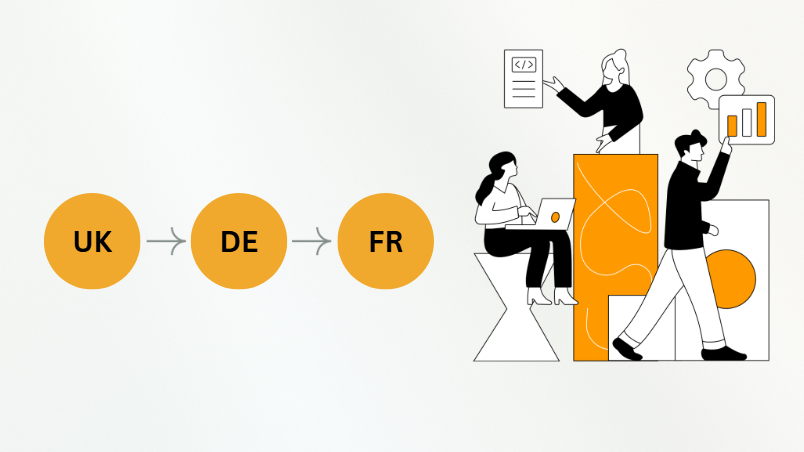
The UK gives you fast signals: which creatives convert, which SKUs gain traction, and how customers react to a tight funnel. You take those insights straight into Germany, where every detail, from listings to documentation, has to be flawless. By the time you enter France, you’re no longer making guesses. You’re optimizing on top of proven data, then layering in the deeper localization and brand nuances that the French market expects.
This step-by-step approach makes more sense. Instead of attacking three very different markets all at once and hoping nothing breaks, you move with intention. Each stage gives you clearer insights, stronger ROI, and a cleaner path to scale. That’s how established accounts win in Europe.
Step 1: Optimizing UK Accounts
Before moving into Germany (DE) or France (FR), the UK serves as your foundation. A strong UK account makes expansion smarter, more predictable, and less costly. This step focuses on understanding current performance, learning actionable lessons, and cleaning up all account data, so that what you bring to DE & FR is optimized, not messy.
Assessing Existing Performance
Evaluating your UK account isn’t just about glancing at a few numbers. Think of it as a full health check: identifying strengths and weak points. Start by reviewing the last 90 days of data to see revenue trends, traffic sources, and which SKUs drive the most sales.
Next, dive into each ad type:
- Sponsored Products: High CTR but low conversion? Listing issues may be the culprit.
- Sponsored Brands: CPC too high compared to benchmarks?
- Sponsored Display: Is your targeting too broad and wasting budget?
Then zoom in on individual SKUs to identify top performers versus products that “burn cash” without producing orders. This step also helps spot early signs of saturation, CPC rising for weeks, TACoS increasing without organic growth, or declining CVR despite stable traffic. By the end, you’ll know what’s worth scaling in DE & FR and what needs fixing first in the UK.
Lessons Learned for DE & FR
The UK is a great market to test because of its moderate competition and fast-feedback data. What you learn here is a guide to avoid mistakes when moving to DE & FR. For example, you will clearly see which types of images get high CTR, which captions drive clicks, or which video ads retain viewers. These insights are very useful when starting in DE & FR, although they still need to be tweaked to suit each country’s culture.
The UK also gives you extremely valuable information about pricing: what prices customers are willing to pay, what types of promotions generate spikes in orders, and how much discounting is safe to do without destroying profit margins.
At the same time, you realize that not all SKUs that sell well in the UK will also sell well in Germany, where customers focus on features and reviews, or in France, where they care more about aesthetics and emotions. From the UK, you will be able to differentiate which products are strong enough to scale and which products need to adjust their strategies when entering new markets.
Data Hygiene & Account Clean-Up
You should give your UK account a good clean-up and use it as a model for DE and FR. Clean data implies transparent reporting, streamlined expenditure, and reduced confusion when expanding.
Key Clean-Up Steps
- Remove overlapping or underperforming campaigns in the last 60–90 days.
- Optimize keywords: delete non-converting keywords, include negative keywords to avoid cannibalization, and cluster similar keywords to manage them better.
- Normalize account structure: use similar naming, isolate prospecting, branded, and competitor campaigns, and eliminate unnecessary ad groups.
- Listing optimization: update titles, bullets, descriptions, change blurry images, and add missing product information.
- Technical checks: ensure tracking is correct, inventories are accurate, and price parity is ensured.
Once you have cleaned, what you are left with is a powerful, structured foundation in the UK, and you are ready to climb efficiently to DE and FR.
Step 2: Localizing for Germany (DE)
Localization is more than just translating your content and launching in Germany. I have witnessed brands fail at this point due to underestimating the differences of the German market. From cultural subtleties to legal rules, it takes a little bit of thinking, accuracy, and a certain patience to be able to get it right. Let’s break it down.
Cultural & Legal Implications
Germany is meticulous. They are conscious of quality, trust, and transparency. You must make your messages reflect that. As an example, the statement about your product must be supported; Germans do not appreciate empty words.
Source: GDPR
Another important thing is the legal environment: compliance with GDPR is not voluntary, and advertising regulations can be strict. Don’t just “translate and go.” Learn about local customs, and you will spare yourself headaches (and fines) in the future.
SEO & Keyword Localization
This is the point at which most brands will fail, assuming that direct translations will capture search intent. German users search differently; they also use compound words or more formal language. It is important that you localize your keywords.
I would always recommend good keyword research using local tools. Don’t copy English titles/meta descriptions directly; they won’t work in German.
Sequenced Rollout Strategy
It is easy to rush and jump into the deep end, but I prefer a gradual approach. Since you have your core products or high-priority campaigns, start with them, track the performance, and then gradually increase. Small problems are simpler to mend before you ever have to scramble through your German catalogue. Imagine that you dip your toes in before committing, and it works.
Step 3: Localizing for France (FR)
France stands out in Europe for its focus on emotion, aesthetics, and brand experience. While Germany emphasizes precision and compliance, France is associated with emotion, aesthetics, and an overall brand experience that feels both chic and authentic. Localization goes beyond translation; it’s about making your brand feel at home culturally, visually, and linguistically.
Cultural and Legal Factors
Let’s examine cultural and legal factors. The French love virtue, narrative, and brands that are lifestyle-oriented, not feature-driven. This should show in your listings, advertising copy, and photos. Avoid inflexible, sales-focused copy; instead, emphasize design, tradition, and style.
Legally, France can be tricky. Advertising claims must comply with local laws, consumer rights are strong, and data processing must follow GDPR, as in Germany. Checking legal aspects before initiating campaigns helps alleviate a lot of pressure in the future.
| IMPORTANT: The French value virtue, storytelling, and lifestyle-oriented brands. Listings, copy, and visuals should reflect design, tradition, and style rather than hard sales. Legally, advertising must comply with local laws, consumer rights are strong, and data processing follows GDPR, so reviewing legal aspects beforehand reduces future risks. |
SEO & Keyword Localization
This is where many brands go wrong: French search behavior is subtle. Users tend to write longer, conversational queries and are sensitive to phrasing. Direct translation from English is rarely effective.
You should invest in good keyword research using local tools, test variations, and consider natural synonyms that make French users feel comfortable. Meta titles, descriptions, and product bullets require a native touch since minor differences in phrasing can influence clicks and conversions. And yes, accents do count; do not leave them out!
Sequenced Rollout Strategy
France should be approached using a data-driven, sequenced expansion strategy after learning from the UK and DE. Begin with your most successful SKUs and campaigns, track responses, and roll out.
Think of this as adding a layer of sophistication. By the time you scale, you will understand what appeals to the French people visually, linguistically, and emotionally. In my experience, a slow, gradual rollout works best, ensuring full integration in the French market.
Cross-Market Insights & Optimization
One of the biggest benefits of expanding in a chain is that you start to see markets “talk” to each other. Each place responds differently, but when you connect these behavioral patterns, optimization becomes clearer and easier.
If a lifestyle image in the UK gets a high CTR, that’s a good sign, but it doesn’t mean it will win 100% of the time in Germany. Germans prefer clear, informational, and accurate images. Meanwhile, the French prefer images that are emotional, beautiful, and “chic.” So instead of creating everything from scratch, you can simply adapt the same set of assets to each culture. This saves time and keeps brand consistency.
The UK tells you how quickly customers accept a price point. Germany tends to be more price-sensitive and wants a “value for money” narrative. France is willing to pay more if the product feels premium or carries a strong identity. When you compare behaviors across all three, finding the right price becomes less guesswork and more pattern recognition.
And once your UK structure is solid, you can copy the skeleton directly into DE and FR, same naming system, same grouping logic, same bidding approach. This keeps reporting clean, lets you compare markets apples-to-apples, and helps you quickly see whether an issue comes from culture, competition, or the structure itself.
Conclusion
When you move from the UK → DE → FR with intention, every market becomes a stepping stone that supports the next. The UK gives you fast data, Germany enforces precision, and France rewards creativity and deep localization. Together, they form a scalable, low-risk blueprint that established accounts can rely on.
Many brands rush into all three markets at once, leading to chaos: duplicated campaigns, messy reporting, compliance issues, and wasted spend. By following a sequenced expansion approach, you stay focused, your team stays sane, and every launch becomes cleaner and more profitable.
FAQs
1. Why do you recommend starting with the UK instead of Germany or France?
The UK gives you the fastest performance signals with lower friction. You get quick data on creatives, pricing, and funnels before entering stricter or more nuanced markets like DE and FR.
2. Can I skip Germany and expand from the UK straight to France?
You can, but I don’t recommend it. Germany gives you structure, compliance discipline, and keyword depth, things that make France easier to scale later.
3. Do I need a native translator for DE and FR?
For ad copy, SEO, and compliance-heavy content, yes, ideally. Literal translations rarely capture cultural nuance, especially in Germany and France.