
EU VAT registration for Amazon sellers becomes mandatory the moment Amazon stores your inventory inside an EU country, not when revenue hits some threshold. That catches many US brands off guard, since US sales tax works differently: you collect it at checkout once you cross a state nexus threshold. VAT doesn’t work that way.
If you’re running FBA into Europe, or your first EU orders are just starting to trickle in, this article is for you, it walks through whether VAT already applies to your setup right now, based on where your stock sits today.
The Core Rule: What Actually Triggers EU VAT Registration for Amazon Sellers
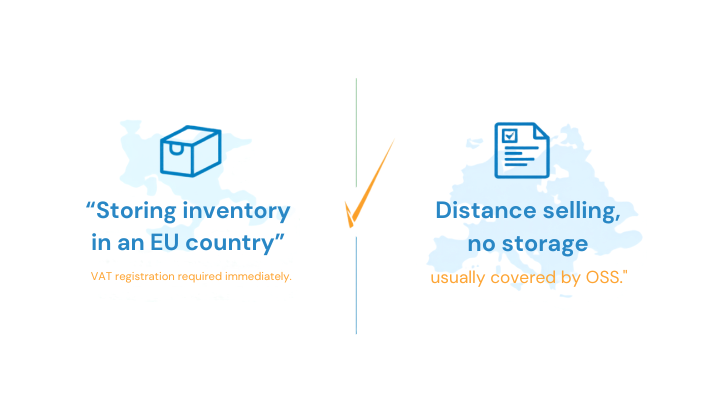
Two triggers matter here, and they work independently of each other, you can hit one without hitting the other.
Storing Inventory in an EU Country Triggers Registration Immediately
If Amazon holds your stock in a warehouse inside an EU country, EU VAT registration for Amazon sellers applies from the very first unit stored, not the first sale. This is the trigger most US sellers underestimate. There’s no revenue threshold, no grace period, and no small-seller exemption for non-EU businesses.
Storing inventory creates what tax authorities call a taxable presence, and it applies the same way whether you’re shipping ten units or ten thousand. Sellers entering through the UK face this exact rule under HMRC, for a closer look at UK-specific registration steps, see our Amazon UK VAT setup guide for manufacturers.
Distance Selling to EU Consumers Without Local Storage
If you’re not storing inventory in the EU but shipping directly to EU customers, a different rule applies. EU-established businesses get an intra-EU threshold of €10,000 per year before destination-country VAT kicks in. The EU VAT threshold for non-EU sellers works differently.
Most distance sales to EU consumers from outside the EU require VAT to be charged from the first qualifying sale, typically reported through the OSS non-Union scheme rather than a stack of local registrations. A lot of US brands assume the €10,000 figure applies to them the same way it applies to EU-based competitors, and it doesn’t. Knowing when to register for VAT EU Amazon sellers depend on, storage versus distance selling, is the first decision that shapes everything else.
- Storing stock in any EU country => registration required immediately, no threshold
- Distance selling only, no EU storage => OSS usually covers you, but confirm per transaction type
- Selling services rather than physical goods, as a non-EU business => the non-Union OSS scheme applies, not the Union scheme
Why the One-Stop Shop (OSS) Doesn’t Solve Everything
Most US sellers hear about OSS and assume it’s a universal fix: one registration, one return, done. It isn’t, and this is the gap that most OSS Amazon FBA VAT explainers skip over.
What OSS Actually Covers
The EU One Stop Shop scheme lets a business register once and file a single return covering cross-border B2C sales across the EU, instead of registering separately in every destination country. For non-EU established businesses selling physical goods, the Union scheme covers cross-border goods sales; the non-Union scheme covers services.
It’s a genuinely useful simplification for pure distance selling, and it cuts down paperwork significantly once a brand sells into more than two or three EU countries.
What OSS Does Not Cover (Pan-EU FBA Storage)
OSS does not replace EU VAT registration for Amazon sellers wherever they hold inventory. Enroll in Pan-EU FBA and Amazon will distribute stock across multiple EU warehouses, Germany, Poland, France, the Czech Republic, and others, and each of those countries requires its own local VAT number, regardless of whether the seller is also registered for OSS.
Pan-EU FBA VAT registration and OSS work alongside each other, not as substitutes. Most growing Pan-EU sellers end up running a hybrid setup: several local VAT registrations tied to storage countries, plus one OSS registration covering everything else. Treating OSS as a replacement for storage-based registration is the single most common misunderstanding among US sellers moving into Pan-EU.
Common Mistakes US Sellers Make with EU VAT
Most compliance problems trace back to a handful of repeated assumptions about EU VAT registration for Amazon sellers, not genuine confusion about the rules themselves.
Assuming One VAT Number Covers All Marketplaces
A German VAT number does not cover sales or storage in France, Poland, or Spain. Each storage country needs its own registration, its own filing schedule, and often its own local-language paperwork.
Sellers who assume one number travels with them across the EU tend to find out the hard way, usually when Amazon blocks inventory transfers into a new fulfillment center until the missing VAT number shows up in Seller Central.
Waiting Until Sales Pick Up to Register
This mistake costs the most. Storage-based VAT registration EU storage countries require isn’t tied to how much a brand is selling; it’s tied to where the stock physically sits. Waiting for revenue to “justify” registration means a seller is already non-compliant the day Amazon moves inventory into a new country.
Back taxes plus penalties accumulate from that date, not from the date the issue was noticed. If VAT numbers aren’t approved before Amazon activates a new storage country, expect blocked transfers, delayed listings, and in some cases a temporary loss of Buy Box eligibility while the paperwork catches up.
EU VAT Registration Requirements by Scenario
Use the table below as a quick reference for where a given setup most likely stands on EU VAT registration for Amazon sellers.
| Scenario | VAT Registration Required? | Why |
| Storing inventory via Amazon FBA in one EU country | Yes, immediately | Storage creates a taxable presence, no threshold applies |
| Using Pan-EU FBA across multiple EU countries | Yes, in every storage country | OSS does not cover storage-based obligations |
| Distance selling to EU consumers, no storage, under €10,000/year (EU-established sellers) | Often not required locally | Home-country VAT rules may still apply below threshold |
| Distance selling to EU consumers, no storage, non-EU established or over threshold | Yes, typically via the OSS non-Union scheme | Destination-country VAT applies |
| Selling FBM only, shipped from a US warehouse | Generally handled by Amazon | Marketplace facilitator rules apply in most cases |
None of these categories are permanent. Switching from EFN to Pan-EU, or adding a new marketplace, can move a business from one row to another overnight, which is exactly why the EU VAT registration for Amazon sellers decision needs revisiting every time the fulfillment setup changes.
Conclusion
Getting US seller EU VAT compliance right from day one costs far less than fixing it after Amazon blocks listings or a tax authority opens a back-tax inquiry. Map the actual storage footprint before activating Pan-EU, not after, know exactly which countries will hold stock, and start those registrations in parallel with the launch timeline rather than treating VAT as a step to handle once sales justify it.
If EU VAT registration for Amazon sellers still feels like a moving target once OSS, fiscal representation, and country-specific filing rules enter the picture, that’s a sign to bring in dedicated support rather than guess. Our Amazon Consulting team helps US brands map VAT obligations against their fulfillment plan before launch.
Sellers unsure which EU countries actually require registration for their setup shouldn’t wait for a suspended listing to find out. Book a free Amazon EU compliance consultation and get a clear view of what’s required before expanding further.
1. Does the EU One-Stop Shop (OSS) replace local VAT registration?
No. OSS simplifies reporting for cross-border B2C sales, but it does not cover VAT obligations created by storing inventory in an EU country. Sellers with stock stored there still need a local VAT number for that country, on top of any OSS registration.
2. Is there a VAT threshold for US-based Amazon sellers?
Not in the way most US sellers expect. The €10,000 intra-EU threshold is designed for EU-established businesses selling cross-border. Non-EU established sellers, including most US brands, typically don’t get that same buffer and often need EU VAT registration for Amazon sellers from their first qualifying sale or first unit of stored inventory.
3. How many VAT registrations do I need for Pan-European FBA?
One per country where Amazon stores inventory. Pan-EU FBA commonly spans multiple EU warehouses, so sellers often end up with several local VAT registrations plus one OSS registration for distance sales outside those storage countries.
4. What happens if I don’t register before Amazon moves inventory to a new country?
Amazon can block or delay inventory transfers into that country until a valid VAT number is on file. Beyond the operational disruption, unregistered storage creates a compliance gap that can trigger back taxes and penalties dating from when the stock first arrived, not from when the issue was discovered.
5. Can one VAT number cover all EU marketplaces?
No. A VAT number registered in one EU country only covers activity in that country. Selling or storing stock in additional countries requires separate registrations, even under the same Amazon Global Selling account.
6. Do US sellers need an EU VAT number before their first sale?
It depends on the trigger. If inventory is stored in an EU country before any sale happens, registration is required from the storage date, not the sale date. If there’s no local storage and sales stay under the applicable OSS or distance-selling rules, the timing for EU VAT registration for Amazon sellers depends on when qualifying sales begin.