
If you have only 90 minutes per month for your account audit, you need a process that’s clear, focused, and genuinely useful. This guide walks you through a three-part account audit framework and a comprehensive checklist to help you review performance, fix structural issues, and spot high-impact optimization opportunities quickly.
Let’s turn a short monthly audit into meaningful improvements for your account.

Part 1: Performance Review in Your Monthly Account Audit
Once you begin examining campaign performance, consider this a full health check of your ad account. This is aimed at identifying the overall trend, unusual patterns, and where performance is failing. This section establishes the basis before proceeding to a deeper diagnosis or optimization.
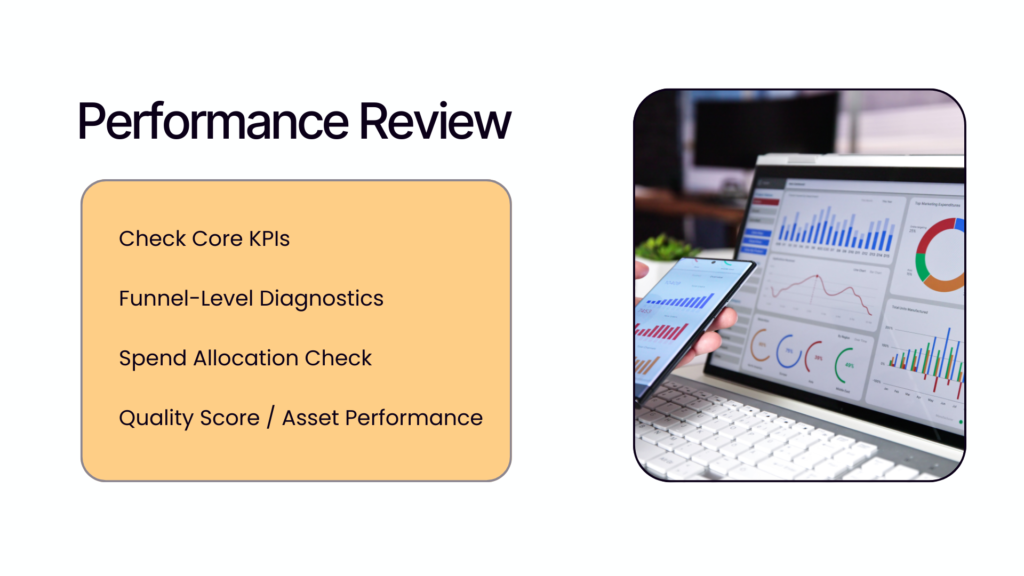
Check Core KPIs
Start by analyzing the most important metrics that reflect the current state of your campaigns: CPA, ROAS, CPL, CTR, and CVR.
Rather than viewing numbers in isolation, compare them month over month to determine whether results are improving. A year-over-year comparison is an additional check that provides good historical context, particularly in seasonal periods when performance tends to vary.
The key activity in this case is determining any KPI that changes by more than 15–20%. A large shift in CPA, a decrease in ROAS, or a decrease in CTR usually indicates that something significant has changed.
This anomaly might be caused by creative burnout, increased competition, targeting issues, algorithmic changes, or tracking issues. Note these anomalies so that you will know where to start digging next.
Funnel-Level Diagnostics
After obtaining a high-level outline, examine each stage of the funnel to identify performance dips. When impressions are deep and clicks are low, you have a top-of-the-funnel issue: improper targeting, ineffective bidding, or poor creative. A decrease in CTR usually implies that the message is no longer interesting.
When users do not convert after clicking, the issue is the post-click experience. This may be a sluggish page, broken format, inconsistent messages, or tracking mistakes. This is where revenue is generated, so you must pay close attention.
Spend Allocation Check
Campaign performance is also determined by budget allocation and ad creative. Most underperforming accounts spend too much on campaigns that are performing poorly. At the same time, solid campaigns do not receive sufficient budget to expand.
Review how funds are being spent. When poor-performing campaigns consume a large budget, they will pull down overall performance. On the other hand, it is common to have an immediate boost when you allocate more funding to campaigns with good ROAS/CPA.
Quality Score / Asset Performance
The role of quality indicators is more significant than many advertisers realize. Your Quality Score declines, and you pay more to get the same traffic, often with lower reach. This typically occurs when your advertisement becomes irrelevant, your message is unclear, or your landing page experience is poor.
Similarly, when many of your resources are rated Low, it is time to adjust your creative message for your audience. This could involve revising the story, refreshing images, or highlighting the product’s unique qualities. Powerful, interactive creatives will always reduce expenditures and enhance reach, and this is an area that should be closely monitored.
Performance Anomalies
Some of the places where one can find anomalies:
- Unexplained spikes in costs
- Traffic does not decline, but the number of conversions is lower
- Abnormal changes in CPM/CPC are generally associated with competition changes or market developments
Address these early by reviewing the changelog, competitive landscape, platform updates, and seasonality factors.
Part 2: Structure & Settings Review
The second step after the performance assessment is to review the structure for soundness.
Campaign Structure Health Check
You should examine the general structure of your campaigns and ad groups. An optimal structure must be systematic and deliberate to enable effective machine learning. When the account appears to be scattered (with too many campaigns that focus on the same theme or overlap), it tends to lead to internal competition and slower algorithmic learning.
Ensure that campaigns have a clear logic: aligned by theme, funnel stage, or SKAG-style precision where needed. Current best practices are more consolidated, providing the algorithm with additional signals and greater flexibility. When you notice that you have several campaigns targeting the same people or competing on the same keywords, it is a strong signal that the account requires declustering.
Targeting Review
For search campaigns, ensure keyword match types align with your strategy. If the campaign relies too heavily on broad match without relevant negative keywords, then you might be paying for unnecessary queries. Conversely, overly restrictive exact-match configurations may limit reach. Another thing to note is that keywords should not compete with each other or trigger similar search terms, which is a common cause of wasted spend.
When using audiences, ensure your remarketing lists are active and populated, your targeted segments are up to date, and your similar audiences are no longer fresh. Many of them blindly post advertisements to outdated lists with low volume.
The settings of the location are also worth considering. It is not unusual to find impressions generated in areas not designed for search, because the default setting targets people in or interested in a location, not necessarily those physically present there.
Bidding & Budget Settings
The bidding strategy determines the way your system allocates traffic. Max Conversion, tCPA, ROAS, whatever you are using, just make sure it is on target. Ensure the campaign has sufficient data for the algorithm to optimize effectively. Smart bidding needs a minimum number of conversions to work.
Performance also depends heavily on your budget. A budget that is too small can render your campaign ineffective and underperform when bidding automatically; a budget that is too large may be wasted, as you tend to spend excessively. Adjusting bids and budgets can help maintain more reliable and stable performance.
Tracking & Conversion Setup
You may have an ideal structure, but a broken tracking system can render it ineffective. Begin by ensuring your pixel or tag is still firing. Conversion tracking can fail due to small webpage changes, such as code edits or layout updates.
Watch out for any signs of double-counting, missing conversions, or conversions firing on the wrong page. The thank-you page needs to load consistently and fire exactly once per conversion. Any anomalies in this case can significantly distort performance metrics and mislead the bidding algorithm.
Part 3: Optimization Opportunities
One is not only aiming to identify issues but also to identify actions that can enhance performance within a short timeframe.
High-Impact Quick Wins
During an account audit, waste is where most improvements can be made. Identify the ad groups or keywords that consistently spend but do not convert. Stop them. This will avoid unnecessary budget overruns and focus on campaigns that actually deliver results.
Meanwhile, the best campaigns should be supported additionally. By increasing its budget, the system will be able to capture higher-quality traffic and scale its results effectively. Thirdly, it is crucial to ensure tracking is precise; without accurate data, even the most effective campaigns cannot be optimized.
Creative & Messaging Actions
Creativity can be revitalized to give new life to campaigns. Creative elements, images, messaging, and copy can account for roughly 50% of advertising performance. Even with perfect structure, poor creativity can limit results.
Creating 2-3 new headlines that include more valuable propositions is also effective to attract attention and get the messaging in line with what users are really searching for. Minor changes in words or benefits can greatly increase engagement or click-through rate.
Call-to-action and other copy should also be reviewed regularly. By streamlining copy to translate into a clear intent, focusing on benefits, and improving CTAs, it is possible to make the user know exactly why they need to be involved or to convert. Even small changes in this case can result in measurable performance improvements.
Landing Page Optimization
Clicks are converted into conversions on your landing page, and minor improvements could produce a disproportionate effect. Work on page speed, especially on mobile devices, and improve user experience.
Then make sure that the content aligns with user intent. Modifying headlines, copy, or layout to describe what users want in your ad will enhance the level of trust and conversion. If needed, run A/B tests to determine which variant performs best.
Audience Optimization
This is an opportunity that can be discovered during an account audit when targeting gaps or opportunities in your audience. Adding new audience signals to Performance Max campaigns provides the algorithm with more context, enabling it to optimize for users more likely to convert.
Replicating patterns of high-performing audiences or expanding similar attributes can increase reach without compromising efficiency, capturing a larger volume of qualified traffic with limited additional expenditure.
Auction Insights & Competitor Analysis
It is essential to understand the competitive landscape to remain on top. Periodically monitor auction knowledge to find out whether rivals are increasing bids or shifting focus. This knowledge will enable you to predict changes in prices and the competitive landscape.
Adjust your bids, messages, or creative approach based on these insights. For example, emphasize distinctive advantages during periods of peak competition, or reduce bids during low-activity periods, to cushion margins and keep campaign activity efficient in the long term.
A monthly framework catches drift. It does not catch a problem that has been there since launch — for that you want a one-off Amazon consulting audit of the whole account.
Conclusion
A 90-minute monthly account audit need not feel intimidating. With a clear structure, you can easily identify what works well, what does not, and where small adjustments would make a huge difference.
FAQs
1. Should I audit every single campaign every month?
Not necessarily. Focus on top-spending and strategic campaigns. Rotating smaller campaigns through the audit cycle works fine, as long as core campaigns get consistent attention.
2. How do I handle sudden KPI spikes or drops?
Check your change logs, seasonality, competitors, and tracking setup. Quick detection prevents long-term efficiency losses.
3. Can small creative updates really make a difference?
Absolutely. Updating headlines, CTAs, or visuals based on current trends or best-performing assets often increases CTR and conversions without major budget changes.